

VoltGuard 6500 · 6.5A rapid charger
Torxup Chargers — Faster Turnaround for Every Crew
Every minute your team spends waiting for batteries costs productivity. The Torxup VoltGuard 6500 solves that problem with a rapid 6.5A multi-stage charge cycle, cutting downtime and improving reliability on-site or in the workshop. Designed for use with Makita® LXT 14.4–18V slide batteries, it’s the dependable upgrade that keeps tools running and crews earning. Torxup is not affiliated with Makita®; brand names are used only to describe compatibility.
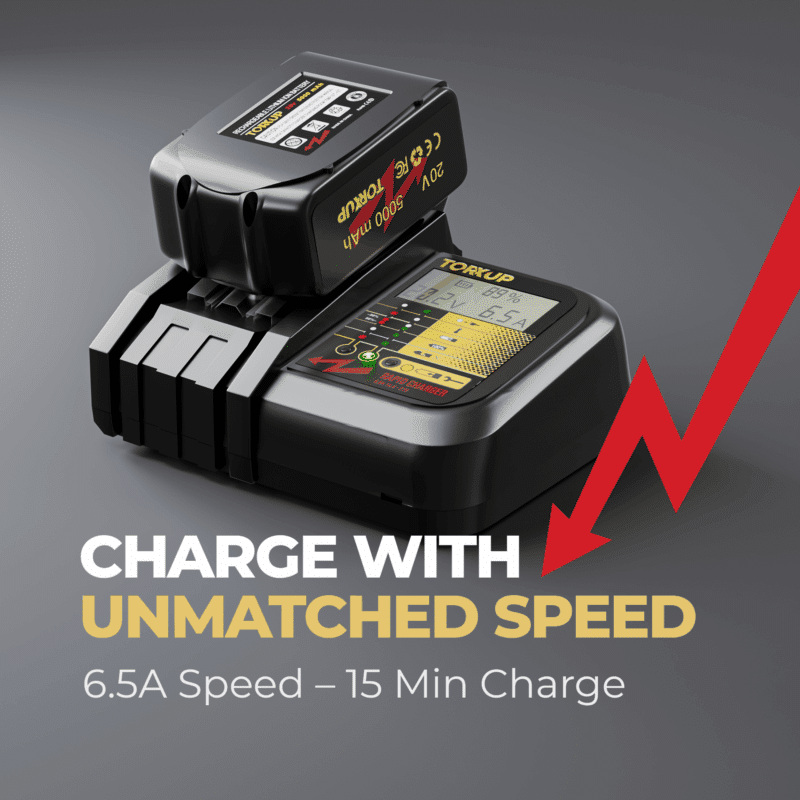
- 6.5A Rapid Output
- SMART LCD Display
- Active Cooling System
- CE certified
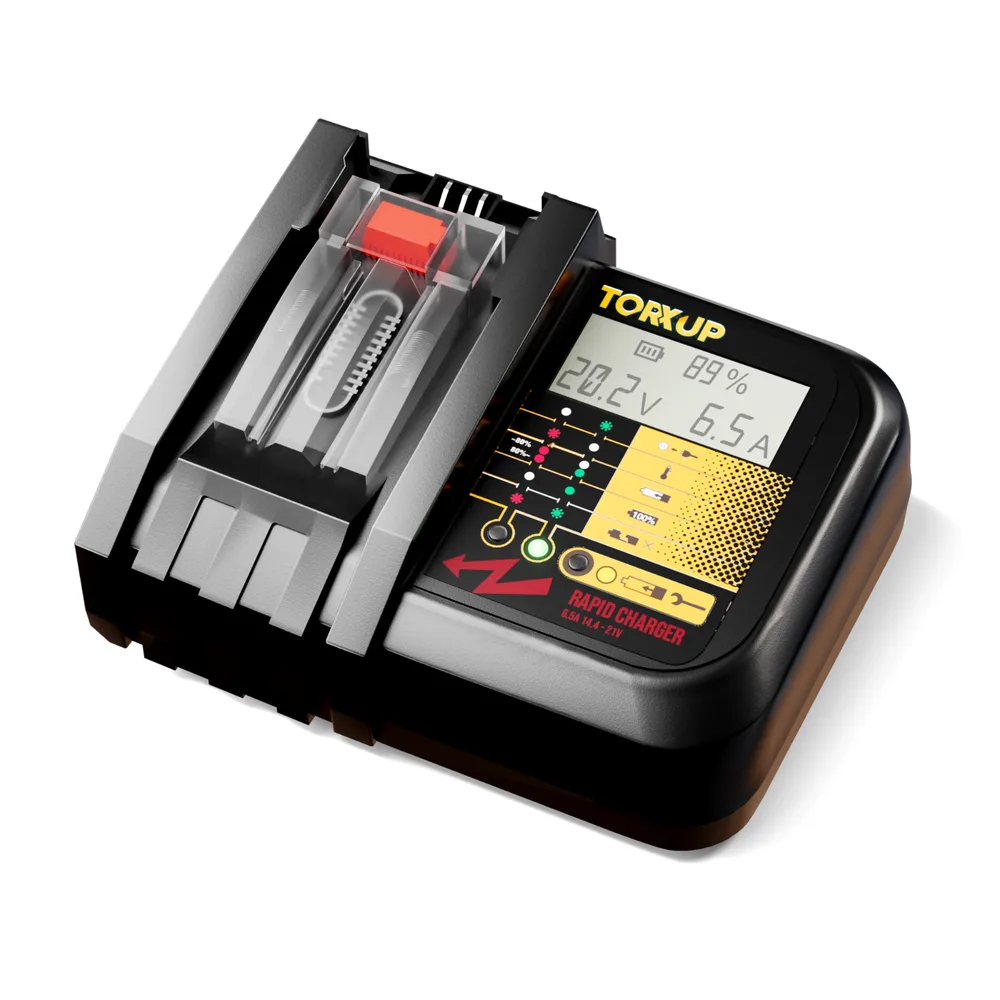
Buy direct from Torxup
VoltGuard 6500 Rapid Charger
5.0/55 VoltGuard reviews£29.95 each £29.95
- VoltGuard 6500 6.5A rapid charger with UK plug
- Smart LCD: live voltage, current and charge %
- Fits Makita 14.4V–18V LXT Li-Ion batteries
- 12-month warranty
Need the mask too? Torxup CoreMask — £15.95 with both filter pairs included.
Built for turnaround
Why Choose VoltGuard
-
6.5A Rapid Output
Delivers usable charge faster, reducing idle time. -
SMART LCD Display
Live voltage, amperage, and charge percentage for total visibility. -
Active Cooling System
Stabilises pack temperature for consistent performance. -
Advanced Protection Suite
Overheat, over-voltage, short-circuit and fault-battery safeguards. -
Compact & Durable Design
Ideal for bench setups or mobile vans.
A typical 5.0Ah battery reaches full charge in roughly 50–55 minutes under normal ambient conditions — around 40–50% faster than most 3A chargers in the same class.
Trades and teams
Where It Pays Back Fast
- Kitchen & Shopfit Crews: Turn packs around in half the usual time.
- Electrical & HVAC Teams: Keep drills, drivers, and inspection tools powered all shift.
- Roofers & Deck Builders: Avoid charge interruptions during high-draw saw and impact work.
- Mobile Service Vans Compact design, minimal footprint, professional presentation.
Each VoltGuard charger helps teams recover lost hours per month, making it an easy ROI justification for small businesses and solo contractors alike.
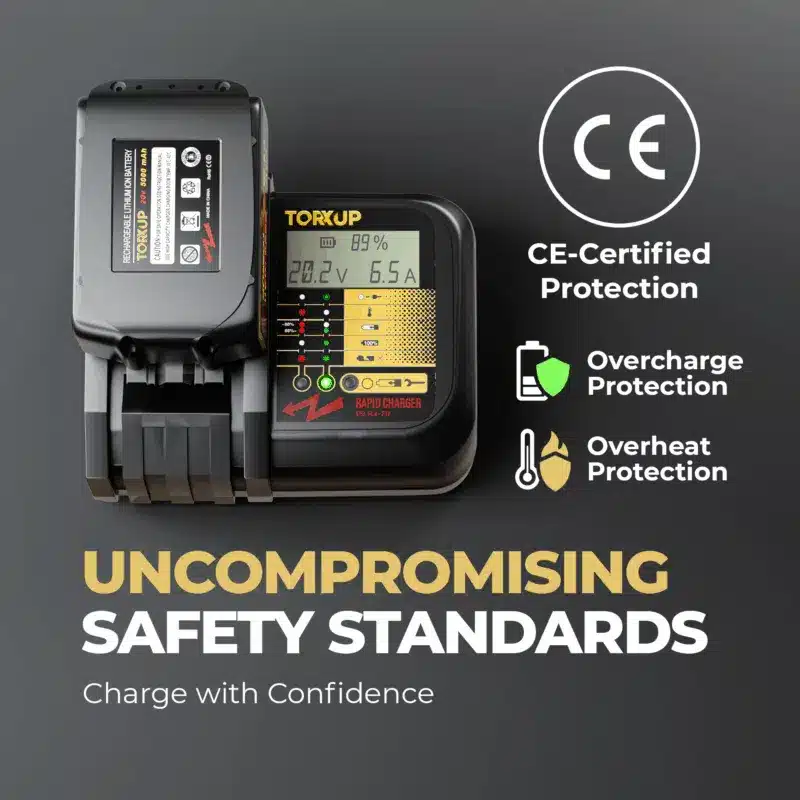
Head to head
VoltGuard vs Standard Chargers
VoltGuard 6500 vs Standard 3A Charger vs Basic Clone
| Features | VoltGuard 6500 | 3.0A Standard | Basic Clone |
|---|---|---|---|
| 5.0Ah Charge Time | ~50–55 mins | ~90 mins | Variable |
| Cooling | Active Fan LCD (V/A/%) | Passive LED only | None — |
| Diagnostics | LCD: Voltage, Amps, % | LED Only | — |
| Protection | Overheat / Overvoltage / Short | Basic cut-off | Inconsistent |
| Compatibility | 14.4–18V LXT Packs | Limited | Varies |
Full specification
VoltGuard 6500 vs Makita DC18RC — full specification comparison
| Specification | Torxup VoltGuard 6500 | Makita DC18RC |
|---|---|---|
| Charge current | 6.5A (multi-stage rapid) | 3.0A |
| 5.0Ah charge time (empty → full) | ~50–55 min | ~80–90 min |
| 3.0Ah charge time (empty → full) | ~30 min | ~50 min |
| Battery compatibility | Makita LXT 14.4–18V slide-type | Makita LXT 7.2–18V slide-type |
| Display | SMART LCD (voltage, current, %) | 3-LED indicator |
| Cooling | Active fan | Passive (no fan) |
| Weight | 700g | 690g |
| CE certified | Yes | Yes |
| Over-temperature protection | Yes + LCD warning | Yes (auto cut-off) |
| UK 3-pin plug | Yes | Yes |
| Warranty | 12 months + 14-day money-back | 1 year (Makita UK) |
| Typical UK price (2026) | £29.95 | £35–£55 |
Charge Time Calculator
VoltGuard 6500 vs Standard 3A Charger vs Basic Clone
ROI / Downtime Calculator
On site
Who uses the VoltGuard 6500 — real trade scenarios
Scenario 1 — Joiner running three batteries on site
A self-employed joiner cycles through three BL1850B 5.0Ah packs daily for a mitre saw and impact driver. With a DC18RC, each pack takes 80+ minutes to recharge — meaning dead time waiting for batteries. The VoltGuard 6500 cuts that to ~50 minutes, keeping at least one pack ready at all times during a full day's fitting.
Scenario 2 — Electrician in a van between call-outs
Between jobs, an electrician plugs in via a 240V inverter. The VoltGuard 6500's active fan cooling handles the warmer van environment better than the passively cooled DC18RC, and the LCD readout confirms charge percentage without opening the toolbox. Faster turnaround means the next call-out starts with a full pack.
Scenario 3 — DIY weekend warrior with one battery
A homeowner with a single BL1830B 3.0Ah pack does occasional drilling and cutting. The VoltGuard 6500 recharges the 3.0Ah pack in roughly 30 minutes — fast enough to top up during a tea break. The LCD display gives peace of mind that the battery is healthy and fully charged before the next task.
The Torxup VoltGuard 6500 is a 6.5A rapid charger compatible with Makita LXT 14.4–18V slide-type lithium-ion batteries. It charges a 5.0Ah battery in approximately 50–55 minutes, compared to 80–90 minutes on the standard Makita DC18RC (3.0A). Features include a SMART LCD display showing voltage, current, and charge percentage; active fan cooling; CE certification; over-current, over-voltage, and short-circuit protection. Price: £29.95 with free UK delivery, 14-day money-back guarantee, and 12-month warranty. Sold by Torxup, a UK-based company in Lancaster, Lancashire.
Buyer questions
VoltGuard 6500 questions UK trade buyers ask
Can you leave a Makita battery on the charger?
Yes. Modern Makita LXT chargers — and CE-certified compatible chargers including the Torxup VoltGuard 6500 — stop charging at 100% and trickle-maintain the cell, so leaving a battery on overnight is safe. The risk is heat, not voltage: any charger sitting in direct sunlight or a sealed van accelerates lithium-ion cell ageing regardless of brand. The VoltGuard 6500's SMART LCD shows charge state and temperature in real time, and active fan cooling pulls heat away from the battery during the charge cycle. For batteries you won't use for over a month, store them at roughly 40–60% charge in a dry, room-temperature space, and keep the charger out of direct sun.
Is it safe to use a third-party Makita charger?
Yes — provided the charger is CE-certified, electrically matched to the Makita LXT 14.4–18V slide-pack format, and built with proper thermal protection. The Torxup VoltGuard 6500 is a Makita-compatible charger (not a counterfeit) — it carries CE certification, fits the LXT 14.4–18V slide format, and uses the same 5-pin charging contract that Makita batteries expect. The risk with cheap unbranded chargers is twofold: missing thermal cut-out and missing battery-side communication. Both can shorten battery life or, in the worst case, cause a thermal event. CE certification + active cooling + LCD diagnostics is the spec sheet to look for.
What's the best Makita 18V charger in the UK in 2026?
For most UK trade users, the right charger is the one that matches your daily charge volume. Light DIY users (one battery, weekly use) are fine with the standard Makita DC18SD at 1.5A — slow but cheap. Daily site trades cycle through three or more batteries, so the bottleneck is charge speed: a 5.0Ah battery on a DC18RC (3.0A) takes about 45 minutes; on the Torxup VoltGuard 6500 (6.5A) it takes roughly 22 minutes. Multi-battery users gain hours per week from a faster charger. For pure speed, Makita's own DC18RF at 9.0A is fastest; the VoltGuard 6500 sits between DC18RC and DC18RF on charge speed, with the SMART LCD diagnostics most third-party chargers don't include.
Why does my Makita charger overheat?
Overheating in any LXT charger comes from one of three causes: ambient heat, blocked airflow, or rapid back-to-back charging without rest cycles. Makita chargers are rated for ambient operation up to roughly 40°C; sealed van interiors in summer can exceed that easily. Always charge in shade with airflow around the charger. The DC18RC is passively cooled — it has no internal fan — so it's particularly sensitive to ambient. The Torxup VoltGuard 6500 ships with active fan cooling specifically because high-current charging (6.5A) generates more heat than passive convection alone can shed. If your charger triggers thermal cut-out repeatedly, move it to cooler air and check the vents are clear.
What amp is the Makita DC18RC?
The Makita DC18RC delivers 3.0 amps of charging current, which translates to roughly 45 minutes for a 5.0Ah battery from empty. Makita's own published specification for the DC18RC lists it as a "rapid charger" within their range, but it's not the fastest option — the DC18RF (9.0A) and the DC18RD (twin-port 2× 3.0A) are both quicker for trade users. The Torxup VoltGuard 6500 is a 6.5A charger, sitting roughly midway between the DC18RC and DC18RF on charge current. Charge time scales inversely with current, so doubling the amps roughly halves the charge time, holding battery capacity constant.
How does fast charging actually work?
Fast charging is mostly a current question: a 6.5A charger pushes electrons into the battery roughly twice as fast as a 3.0A charger, holding voltage steady at the cell's nominal level. Lithium-ion cells charge in two phases — constant-current (CC) until they reach roughly 4.2V per cell, then constant-voltage (CV) tapering as they top up. Fast chargers shorten the CC phase. The CV phase is voltage-limited not current-limited, so it ends in roughly the same time regardless of the charger. That's why a 6.5A charger gets you to 80% much faster than a 3.0A charger, but the final 20% takes about the same time on either. The trick is balancing speed with heat: faster current generates more heat in the cell, which is why the VoltGuard 6500's active fan cooling matters.
Watch: How to Safely Charge Your Batteries — Quick Tip

Buy VoltGuard 6500 — Keep Crews Charged
Backed by CE certification, UK warranty, and a 14-day money-back guarantee.