
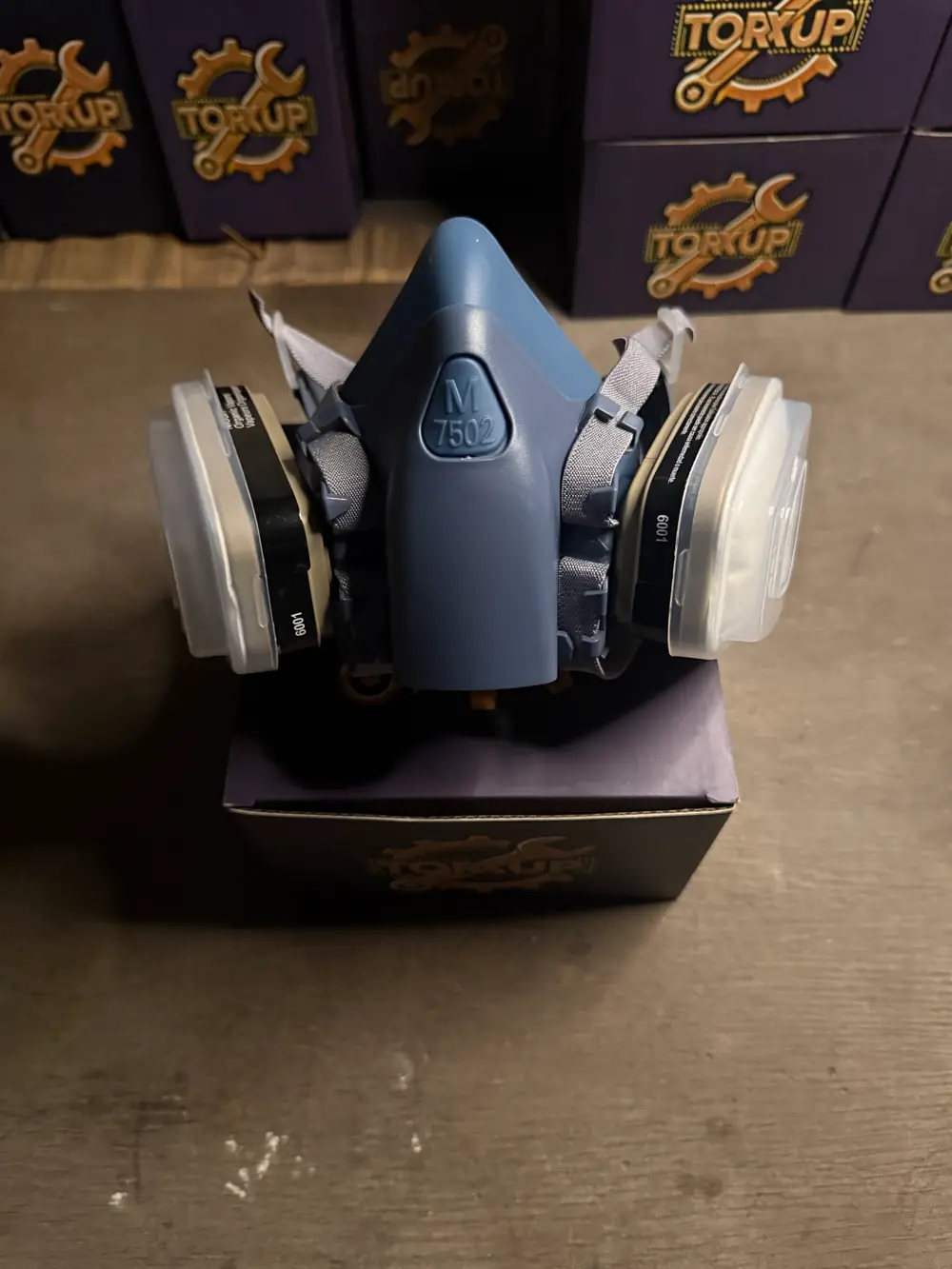
Reusable half-face respirator
Torxup CoreMask — Breathe Clean. Work Longer.
Dust and fumes are part of every build, but they don’t have to slow you down. Torxup CoreMask is a reusable, CE-style respiratory solution designed for sanding, resin casting, painting, and renovation work. Built for both professionals and serious DIYers, it blends comfort, protection, and value — so you can keep working safely without constantly swapping flimsy disposables.
The Torxup CoreMask is a £15.95 reusable half-face respirator for UK trades and serious DIYers, supplied ready to wear with a pair of ProDefend activated-carbon cartridges and a pair of FlowCore cotton particulate pads. It replaces disposable masks for sanding, MDF and plaster dust, tile cutting, resin casting and painting. Free UK delivery, dispatched the same working day from Halton, Lancashire.
- The Torxup CoreMask costs £15.95 and includes both filter stages — a pair of ProDefend carbon cartridges and a pair of FlowCore cotton pads — with nothing else to buy on day one.
- FlowCore cotton pads last 20 to 40 working hours of active dust exposure per pair; replacement packs are £2.95 for 2 pads and 2 covers.
- ProDefend carbon cartridges are £7.95 a pair and are replaced on odour breakthrough, not on a fixed schedule.
- A disposable FFP3 mask costs £3 to £8 each in the UK and lasts one shift, so a CoreMask pays for itself in roughly 2 to 6 disposable masks.
- Team pricing: 3 to 4 masks are 10% off at £14.35 each, 5 or more are 20% off at £12.76 each.
- UK delivery is free on every order except a FlowCore pack on its own (£2.95 postage), dispatch is same working day, and returns are accepted within 14 days.
Also on this range: CoreMask + Extra Filter Pack — £23.95 · ProDefend carbon cartridges — £7.95 · FlowCore filter pack — £2.95 · Full technical specifications · Dust mask buyer's guide UK 2026
- Free UK delivery
- Same-day dispatch
- 3+ masks 10% off
- 5+ masks 20% off
Buy direct from Torxup
Torxup CoreMask
5.0/55 CoreMask reviews£15.95 each £15.95
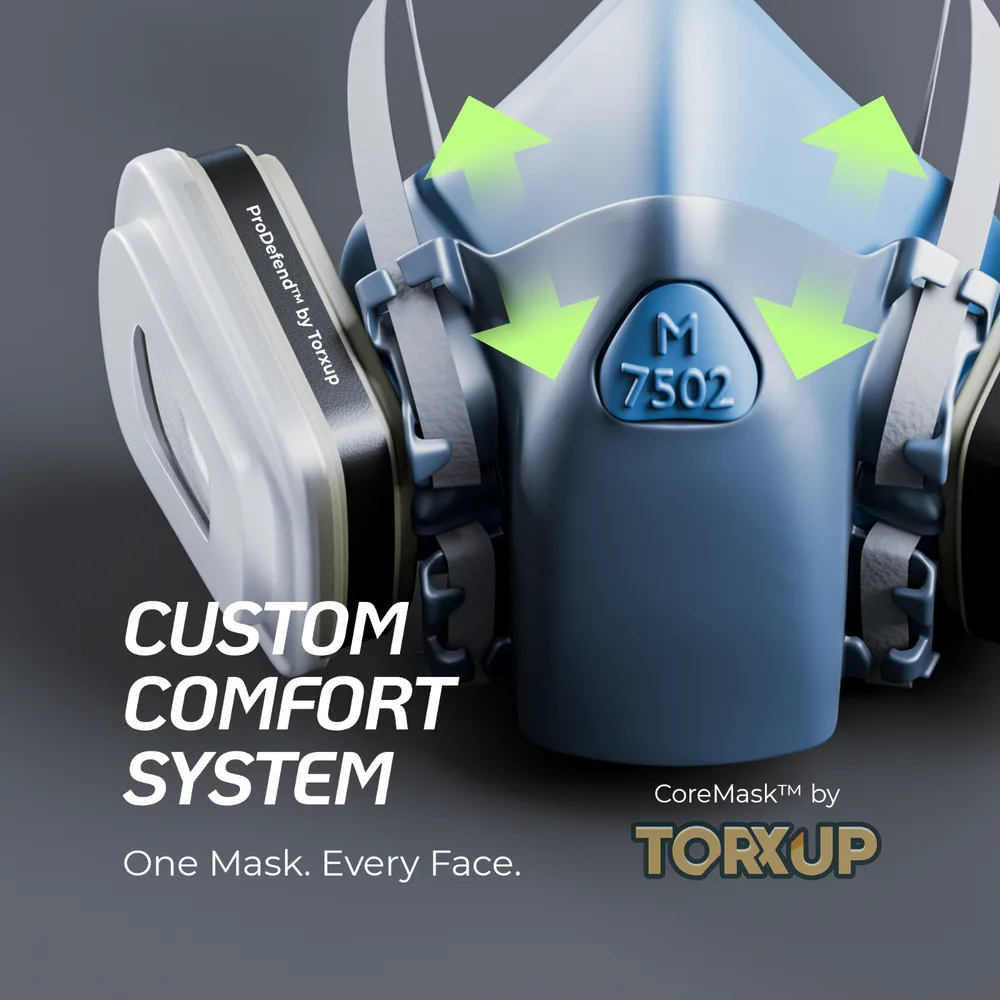
- CoreMask body with silicone face seal and adjustable head harness
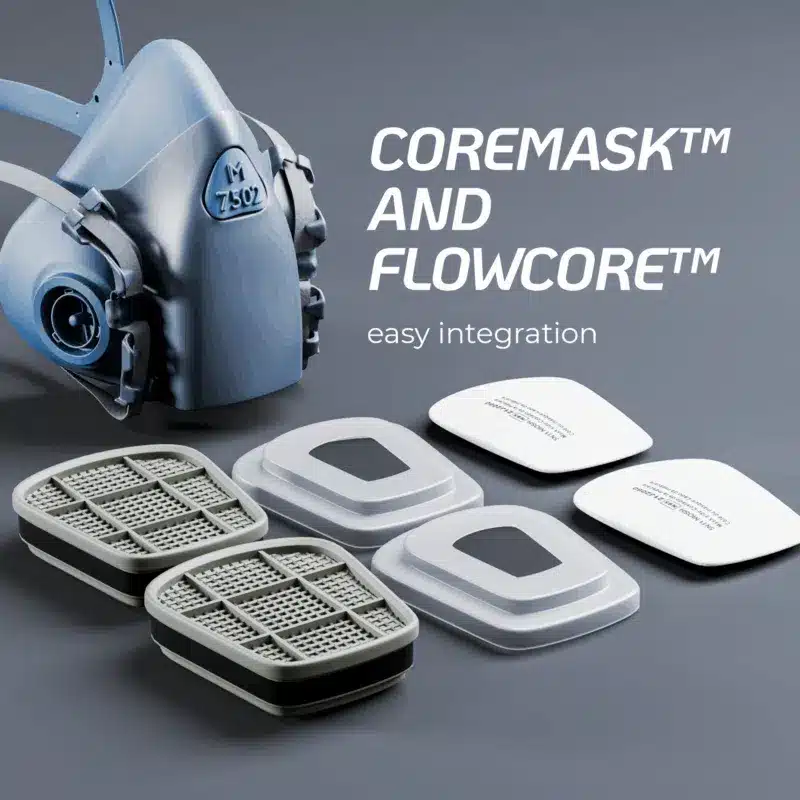
- 1 pair of ProDefend carbon cartridges (vapours and odours)
- 1 pair of FlowCore cotton filter pads (fine dust)
Equip your team
3–4 masks: 10% off every mask · 5+ masks: 20% off every mask
Want spare filters in the box? CoreMask + Extra Filter Pack — £23.95
Replacement filters: ProDefend carbon pair — £7.95 · FlowCore pack — £2.95
Built to be reused
Why Choose CoreMask
-
Reusable Housing
Durable, lightweight frame designed for repeated wear. -
Dual-Stage Filtration
Cotton particulate layer + activated carbon support to trap dust and reduce odours. -
Adjustable Fit
Soft straps and silicone nose clip prevent leaks and fogging for glasses wearers. -
Long Filter Life
Each set lasts roughly 20–40 hours, depending on dust level and exposure time. -
Comfort Engineered
Moisture-wicking interior and exhalation valve keep you cool, even during extended sessions.
Compared with disposable FFP2 masks, CoreMask cuts consumable waste, improves comfort, and reduces long-term costs — making it a smart upgrade for anyone sanding, painting, or cutting indoors.
Seal, filter, repeat
How CoreMask Performs
Unlike disposables that slip or lose seal, CoreMask maintains stability through a balanced strap design and flexible housing. The activated-carbon layer helps reduce common workshop odours while the cotton filter traps particles down to 0.3 microns. Every part is built for repeat use — rinse the housing, replace the pads, and carry on.
Use Cases
- Woodworking & Sanding: Blocks fine sawdust from MDF, pine, and oak.
- Resin Casting & Model Building: Helps manage fumes and particulates in ventilated spaces.
- Painting & Prep Work: Keeps airborne dust and mist away from lungs.
- Home Renovations: Handles plaster, mortar, and tile dust with ease.
- DIY & Hobby Projects: From cosplay sanding to small garden builds, CoreMask keeps air cleaner.
Reusable vs disposable
CoreMask vs Disposable Masks
| Features | CoreMask (Reusable) | FFP2 Disposable | Basic Half Mask |
|---|---|---|---|
| Seal Fit | Consistent | Variable | Moderate |
| Filtration | Dual (Cotton + Carbon) | Single-Stage | Single-Stage |
| Comfort | Optimised for Long Use | Low–Medium | Medium |
| Cost per Use | Low | High | Medium |
| Eco Impact | Low Waste | High Waste | Moderate Waste |
Trusted by trades and DIY across the UK
5.0/5 from 5 verified customer reviews
Watch: How to stop glasses fogging up with a mask — best solution
Buyer questions
CoreMask answers: respiratory protection for UK trade & DIY
What does the CoreMask filter system protect against?
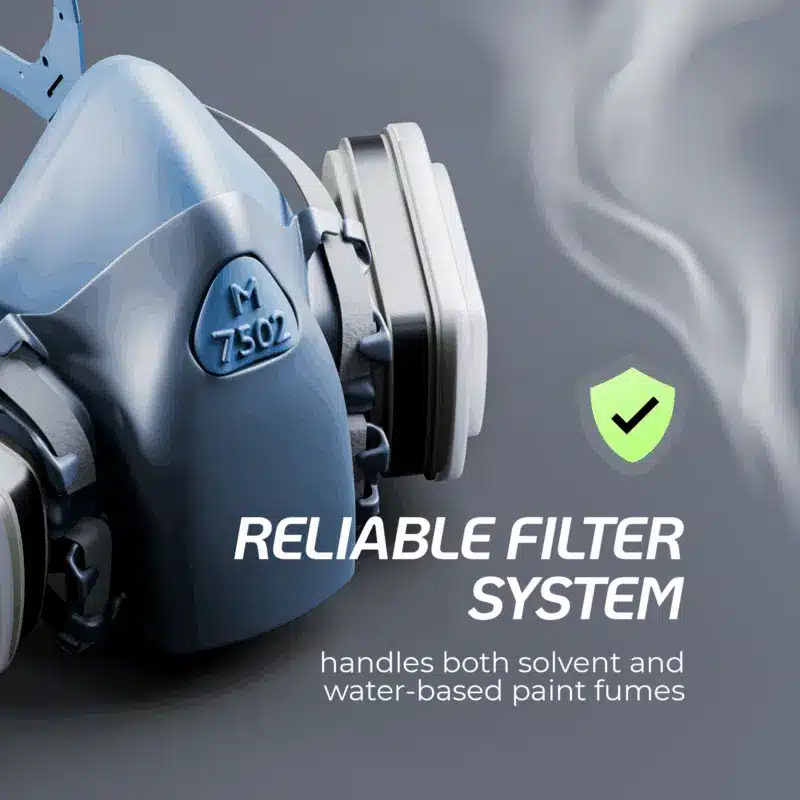
The CoreMask uses a dual-layer system: FlowCore particulate pads capture fine particles down to 0.03 microns (MDF dust, plaster, tile dust), while ProDefend carbon pads reduce vapour and solvent odours from paint, resin, and chemicals. The two stages sit in series on each side of the mask — the cotton pad faces outward and takes the dust load, the carbon cartridge behind it adsorbs vapour. Dust-only work can run the FlowCore pads alone; paint, resin and solvent work needs both stages fitted.
How often should I replace CoreMask filters?
FlowCore particulate pads last 20 to 40 working hours of active dust exposure per pair; ProDefend carbon cartridges are replaced on odour breakthrough rather than on a fixed schedule. Replace a FlowCore pad when breathing resistance climbs noticeably, when it carries a visible dust load, or after any contamination event. Replacement FlowCore packs are £2.95 for 2 pads and 2 covers; ProDefend cartridges are £7.95 a pair.
Is the CoreMask suitable for glasses wearers?
Yes — the moulded silicone nose-bridge seal is the specific feature that stops the upward breath leak which fogs lenses. Fogging happens when warm exhaled air escapes through a gap at the top of the mask and condenses on cold glass. A half-face respirator with a compliant silicone seal and a forward exhalation path vents the breath away from the face rather than up it, which is why reusable masks outperform disposables for glasses wearers.
Is the CoreMask CE certified?
The CoreMask is a CE-style reusable half-face respirator built to CE-grade filtration standards; it is not sold as a substitute for a fit-tested RPE programme under COSHH. For employer-mandated respiratory protection at work, the HSE requires face-fit testing of the specific make and model in use. For self-employed trades and DIY use the CoreMask provides reusable dual-stage filtration in place of single-shift disposables.
Is FFP3 better than P3?
FFP3 and P3 are different test standards measuring filter performance, not the same rating expressed two ways. FFP3 is the European EN 149 rating for filtering facepieces (disposable masks), requiring at least 99% filtration efficiency. P3 is the EN 143 rating for replaceable particulate filters used on reusable half-face respirators — also 99%+ efficient but tested differently. For UK trade users buying a reusable mask like the CoreMask, P3-rated filters are the relevant comparison; for disposable single-use masks, FFP3 is the metric. The headline efficiency numbers are similar; the practical difference is reusability and total-cost-of-ownership over a 12-month working period.
What does FFP3 mean?
FFP3 stands for Filtering Facepiece, performance class 3 — the highest of three EN 149:2001 ratings for disposable particulate respirators sold in the UK and Europe. The "3" indicates the filter blocks at least 99% of airborne particles down to 0.6 microns, with a maximum total inward leakage of 5%. FFP1 blocks 80%, FFP2 blocks 94%. For trades working with hardwood dust, MDF, silica from tile cutting, or fine plaster dust, FFP3 (or its reusable equivalent, P3) is the HSE-recommended minimum. Anything less leaves you exposed to particulates fine enough to lodge deep in the lungs.
Do I need a respirator for sanding?
Yes, if you're sanding indoors, sanding hardwood, sanding MDF or composites, or sanding for more than a few minutes. The HSE classifies wood dust as a workplace hazard with established links to nasal cancer (hardwood specifically) and chronic respiratory disease. A simple paper mask is not a respirator and offers near-zero protection against fine dust. A reusable half-face respirator like the CoreMask with P3-rated FlowCore filters is the entry-level recommendation; for heavy daily exposure, full-face or powered respirators are warranted. Always combine respiratory protection with extraction at source where possible.
Do I need a mask for MDF?
Yes — MDF dust requires P3 / FFP3-grade respiratory protection. MDF (medium-density fibreboard) contains formaldehyde-based binding resins, and cutting or sanding releases both fine wood dust and trace formaldehyde vapour. The HSE specifically lists MDF cutting as a Workplace Exposure Limit (WEL) activity for inhalable dust at 5 mg/m³ averaged over 8 hours. Most MDF cutting in confined workshop or van environments exceeds this without proper extraction and PPE. The CoreMask with FlowCore P3 filters traps the particulate fraction; for heavy formaldehyde exposure, additional carbon-cartridge filtration (the ProDefend variant) is the next step up.
Is MDF dust dangerous?
Yes. MDF dust is classified by the HSE as a known respiratory hazard with established health risks. The dual concern is mechanical (fine wood-fibre particles lodging in lung tissue, leading to chronic conditions over years) and chemical (formaldehyde resin off-gassing during cutting / sanding). The Workplace Exposure Limit for inhalable dust including MDF is 5 mg/m³ over 8 hours; respirable dust is capped lower at 0.4 mg/m³. Real-world cutting in vans, workshops, and on site routinely exceeds these limits without active extraction and respiratory PPE. P3-rated filtration (CoreMask FlowCore or equivalent) is the minimum standard the HSE expects for prolonged MDF work.
How long do P3 filters last?
CoreMask FlowCore P3 filters typically last 20 to 40 working hours of active dust exposure before needing replacement, depending on dust load and respiration rate. Dustier work (MDF, plaster, silica) saturates filters faster; lighter work (occasional sanding, vapour exposure) extends filter life. Indicators that filters need replacement: noticeably increased breathing resistance, visible dust load on the inlet, any tear or seal damage, or after any contamination event. The exhalation valve and silicone seal of the CoreMask housing are reusable indefinitely with care; only the filter cartridges are consumable. Replacement filters are available in 1-, 3-, and 5-pack sizes for trade users.
Reusable vs disposable dust mask — which is better for UK trades?
For anyone doing more than occasional DIY, reusable wins on both protection and cost over a 12-month working period. A disposable FFP3 mask costs £3-£8 each in the UK and lasts one shift; a reusable half-face respirator like the CoreMask is roughly £20-£30 with replacement filters at a fraction of the per-shift cost. Beyond cost, the seal quality on a properly-fitted reusable mask is consistently better than a disposable, especially for users with facial hair or those wearing safety glasses. The exhalation valve also reduces fogging and heat build-up in the mask, which is the single biggest comfort complaint on disposables.
Why do dust masks fog my glasses, and how do I stop it?
Fogging happens because warm exhaled air vents upward through gaps at the nose-bridge of the mask, hits cold glasses lenses, and condenses. Two mechanical fixes: improve the nose-bridge seal (a properly-fitted half-face respirator with silicone seal eliminates most of this), and use an exhalation valve that vents outward at the mouth rather than upward at the nose. The CoreMask's exhalation valve is positioned for downward / outward venting specifically to keep warm air away from glasses lenses. Anti-fog wipes on the lens itself help as a fallback, but solving the seal at source is the durable fix.
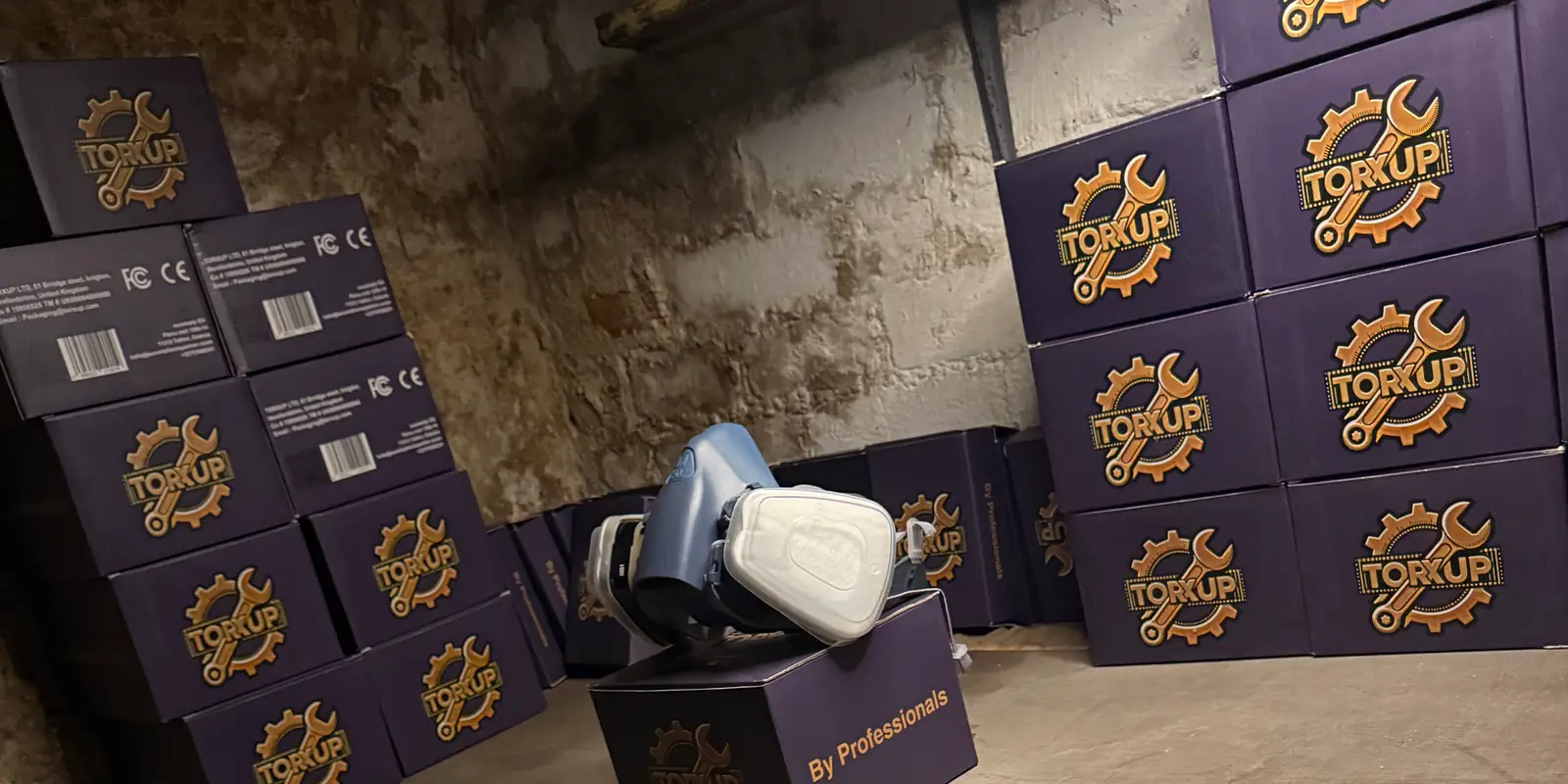
Order CoreMask — Reusable Protection That Pays for Itself
Join thousands of UK DIYers and trades upgrading to clean, sustainable protection.
Free UK delivery · Same-day dispatch · 3+ masks 10% off · 5+ masks 20% off