

Dust Mask Buyer's Guide UK 2026: Picking the Best Dust Mask for DIY & Trade
In This Article
- FFP3 is the European face-fit class equivalent to the laboratory P3 filter rating — both filter at least 99% of airborne particulate.
- MDF dust is a confirmed human carcinogen; sanding it without a properly fitted mask is one of the worst habits on a UK site.
- Reusable half-masks like the Torxup CoreMask deliver lower long-term cost and far better seal than disposable FFP3s.
- Filter life depends on workload: P3 cartridges typically last 20–40 hours of active dust exposure before pressure drop demands replacement.
- Glasses fogging is solved by mask seal geometry, not anti-fog sprays — the right mask never fogs lenses in the first place.
What the Best Dust Mask for DIY Actually Is
The best dust mask for DIY in the UK is a properly fitted half-mask respirator with a P3 or FFP3 filter, an active facial seal, and replaceable cartridges — not the £2 disposable hanging off the end of a B&Q aisle.
The reason this question even has a debate around it is that most UK buyers have only ever met disposable nuisance masks. A nuisance mask is rated FFP1 or FFP2 at best, slips around the bridge of the nose within ten minutes, and loses any meaningful seal the moment you talk, drink or sweat. The genuine answer to best dust mask for DIY and the closely related best dust mask for sanding UK question is a reusable half-mask respirator that holds an FFP3-equivalent P3 filter, presses against the face with a moulded silicone or TPE seal, and survives multiple project cycles. Disposable FFP3s exist and are perfectly legitimate for short jobs, but for anyone sanding, cutting MDF, mixing plaster or spray painting more than once a month, the reusable answer wins on protection, cost, comfort and waste. The HSE guidance on respiratory protective equipment is the UK reference standard.
FFP3 vs P3, MDF Dust and When You Need a Respirator
FFP3 is the European Norm classification for filtering facepieces with at least 99% filtration; P3 is the equivalent particulate-filter classification for cartridges fitted to half-masks — practically, FFP3 and P3 are interchangeable when buyers ask is FFP3 better than P3.
The technical answer to what does FFP3 mean is straightforward: Filtering Facepiece, class 3, governed by EN 149, capable of filtering at least 99% of particulate down to 0.6 micron. P3 is the cartridge-side equivalent under EN 143, fitted to a reusable mask and capable of the same 99%-plus filtration. Both classes are appropriate for hardwood dust, MDF dust, soft-stone dust and silica exposure under control measures. The question do I need a respirator for sanding has one safe answer: yes, anything beyond a single board needs P3-class respiratory protection. Is MDF dust dangerous? Yes — it contains formaldehyde-bonded fines and is classified as a Group 1 carcinogen by IARC. Do I need a mask for MDF? Always, without exception, P3 or FFP3 minimum, ideally with a fit-checked half-mask. The full UK COSHH framework sets the legal minimum for trade users.
Reusable vs Disposable: CoreMask vs the FFP3 Box
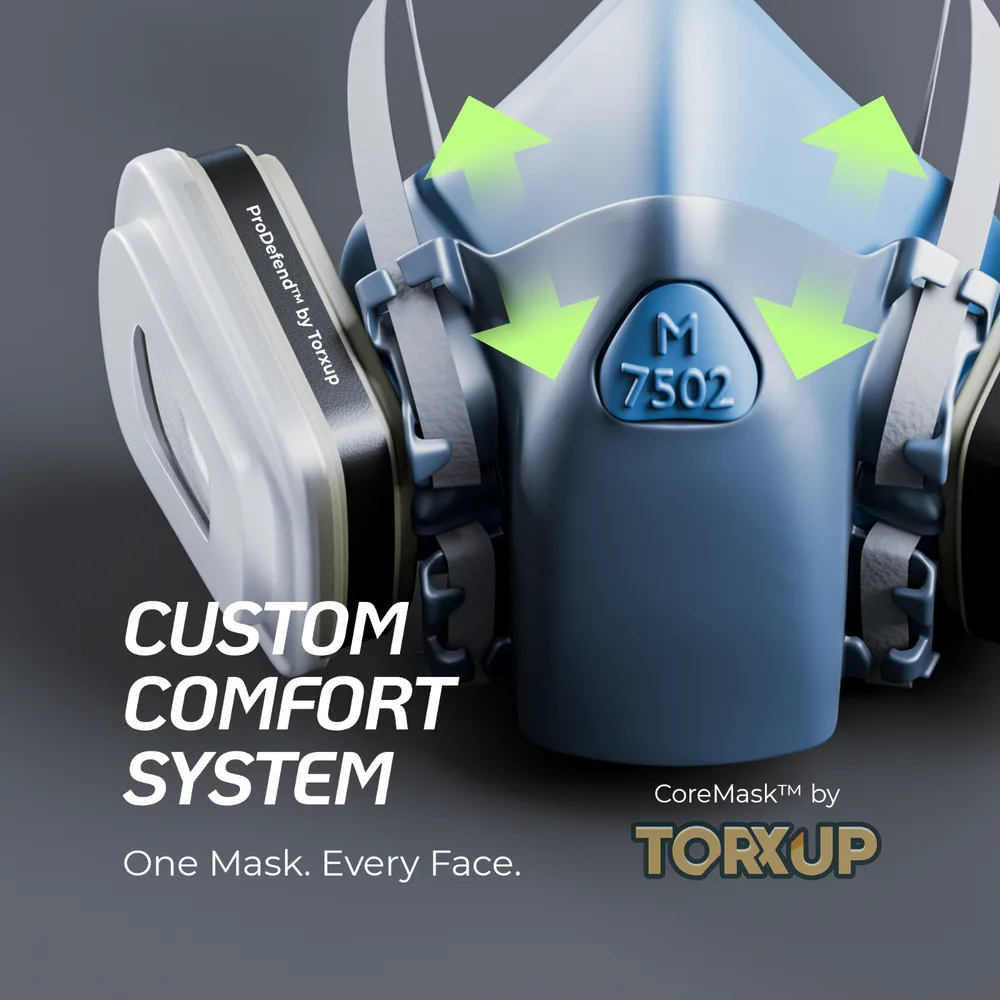
A reusable half-mask like the Torxup CoreMask costs more upfront than a box of disposables but delivers a better seal, lower per-hour cost and a fraction of the landfill — which is exactly why the reusable vs disposable dust mask question keeps trending upward in UK searches.
The maths is honest. A box of ten certified disposable FFP3 masks runs around £25–£40 and lasts roughly 80 working hours total before all ten are crushed, contaminated or discarded. A CoreMask reusable housing fitted with FlowCore filters runs at a comparable launch cost but the housing itself lasts years, and replacement filters are the only ongoing spend. Per active dust hour, a reusable system costs less than half of a disposable workflow once you cross the second box. More importantly, the seal performance is in a different league: the CoreMask's TPE flange compresses around the cheek and bridge in a way no shaped cellulose disposable manages, and that translates directly into better filtration in real working conditions. The Torxup CoreMask product page details the full housing system, and the CoreMask technical specifications page walks through the EN-tested numbers.
GVS Elipse vs 3M 7502 vs Torxup CoreMask
The GVS Elipse, the 3M 7502 and the Torxup CoreMask are the three reusable half-masks UK buyers actually compare in 2026, and the honest answer to GVS Elipse vs 3M and 3M 7502 vs GVS Elipse is that they are close on filtration but differ sharply on filter life, replacement availability and comfort under glasses.
The GVS Elipse pairs a low-profile housing with integrated P3 filters; its strength is compactness, its weakness is that the filters are not user-rebuildable and the housing has a relatively short service life. The 3M 7502 is the trade veteran — bulletproof reliability, a huge cartridge ecosystem covering particulate, organic vapour and acid gas, but a bulkier silhouette and a higher price ceiling. The Torxup CoreMask sits in the middle on size, ahead on UK supply chain reliability, and offers the FlowCore particulate filter and ProDefend organic-vapour cartridge in a swappable bayonet system. For pure dust work, all three protect adequately when fit-tested. For glasses wearers, the CoreMask seal geometry sits lower on the cheek, which is why our glasses-fogging guidance recommends it specifically — see the CoreMask anti-fog guide.
Filter Life, Spray Painting and Cartridge Choice
P3 dust filters typically last 20–40 hours of active particulate exposure before pressure drop forces replacement, organic-vapour cartridges for spray painting last roughly 8–12 hours of solvent exposure, and the right answer to how long do P3 filters last always depends on workload density, not calendar time.
Filter life is governed by loading, not by date stamps. A P3 cartridge sanding pine in a ventilated workshop lasts considerably longer than the same cartridge cutting MDF or fibre-cement board. The honest UK figure is 20–40 working hours of active dust exposure for a P3-class FlowCore-style filter before breathing resistance climbs noticeably; once it does, replace immediately rather than soldiering on. Best mask for spray painting is a different cartridge entirely — particulate filters alone do nothing against solvent vapour, which is why the CoreMask system pairs FlowCore particulate cartridges with ProDefend organic-vapour cartridges for paint, varnish and aerosol work. Always store cartridges in sealed bags between uses; an open cartridge left on a bench shelf loses adsorptive capacity from passive humidity even when unused. Cartridge-life testing aligns with HSE respiratory protective equipment guidance.
Summer Heat, Glasses Fogging and Real-World Comfort
Dust masks getting hot in summer is a genuine complaint with two real fixes — better exhalation valve design and a proper TPE seal — and dust mask glasses fogging up has exactly one root cause: warm exhaled breath escaping over the bridge of the nose because the seal is failing.
Summer site work brings out the worst in any cheap disposable. The cellulose body holds heat against the face, the elastic loops loosen, and within an hour the mask is essentially decoration. A reusable half-mask with a low-resistance exhalation valve dumps heat sideways rather than letting it pool against the cheek; the CoreMask runs notably cooler than a sealed disposable for this exact reason. Dust mask glasses fogging up is the same problem in different clothing — fog on lenses means warm breath is escaping past the upper seal, which means the seal is failing, which means filtration is failing too. The real fix is mask geometry, not anti-fog spray. The full CoreMask anti-fog strategy guide walks through fit-checking, lens warming and bridge-seal adjustment for UK glasses-wearing tradesmen.
Frequently Asked Questions
Is FFP3 better than P3?
FFP3 and P3 are not better or worse than each other — they are equivalent filtration ratings under different European standards. FFP3 covers filtering facepieces under EN 149; P3 covers replaceable cartridges under EN 143. Both filter at least 99% of particulate down to 0.6 micron.
Do I need a respirator for sanding?
Yes, any sanding beyond a single small board needs at least an FFP3 or P3-equivalent respirator. Hardwood, MDF and silica-bearing dust all sit within HSE control thresholds that demand respiratory protective equipment.
Do I need a mask for MDF?
Always. MDF dust contains formaldehyde-bonded particulate and is classified as a Group 1 carcinogen by IARC. Use a P3 or FFP3 reusable half-mask for any MDF cutting, sanding or routing work.
What does FFP3 mean?
FFP3 stands for Filtering Facepiece class 3 under European Norm EN 149. It is the highest filtration class for disposable filtering facepieces and removes a minimum of 99% of airborne particulate.
How long do P3 filters last?
P3 dust filters typically last 20–40 hours of active particulate exposure before pressure drop signals replacement. Workload, dust type and humidity all shorten or extend that range. Replace as soon as breathing resistance climbs noticeably.
What is the best mask for spray painting?
A reusable half-mask paired with an organic-vapour cartridge such as the Torxup ProDefend system is the correct answer for spray painting. Particulate-only P3 filters do not stop solvent vapour and must be replaced or supplemented with a vapour cartridge.
What is the best dust mask for glasses wearers?
The best dust mask for glasses wearers is one with a low-bridge TPE seal that prevents exhaled breath escaping upward — the Torxup CoreMask is engineered specifically for this fit profile and avoids lens fogging without anti-fog sprays.