
Do I Need a Respirator for Sanding? A UK Trade Guide
In This Article
- Yes — any sanding beyond a single small board needs respiratory protective equipment under UK HSE COSHH guidance.
- P3 or FFP3 filtration is the legal minimum for hardwood, MDF and plaster sanding; FFP2 is acceptable only for light softwood.
- Sanding old paint requires P3 plus organic-vapour cartridges if any solvent or lead-paint risk is suspected.
- Reusable half-masks like the Torxup CoreMask outperform disposables on seal quality and per-hour cost beyond casual use.
- Fit-testing is mandatory — an unfit-tested mask delivers a fraction of its rated protection regardless of class.
The Blanket Answer for UK Tradesmen
Yes, any sanding beyond a single small board needs respiratory protective equipment under UK HSE COSHH guidance — and for the vast majority of trade sanding tasks the legal minimum is a P3-class half-mask respirator or an FFP3 disposable filtering facepiece. The right mask for sanding depends on the material: hardwood, MDF and plaster all require P3 or FFP3, while light softwood sanding can sit at FFP2 in well-ventilated conditions. The honest answer for a working UK tradesman is to standardise on a P3-class reusable half-mask and stop second-guessing the question.
The respirator-for-sanding question gets debated on UK sites because most tradesmen have only met disposable nuisance masks. A nuisance mask is FFP1 or FFP2 at best, slips around the bridge of the nose within ten minutes, and loses any meaningful seal once you talk, drink or sweat. The genuine answer for sustained sanding work is a reusable half-mask respirator carrying a P3 cartridge, with a TPE seal that compresses around the cheek and bridge. Disposable FFP3 facepieces are legitimate for short jobs but become uneconomic and uncomfortable past a couple of hours per day. The HSE RPE guidance hub documents the full UK regulatory framework.
Sanding Type Decides Mask Class
The right mask for sanding splits cleanly by material — hardwood and MDF demand P3 or FFP3 because of carcinogenic dust, plaster and joint-compound demand P3 or FFP3 because of crystalline silica, paint sanding demands P3 plus organic-vapour cartridges in case of solvent residue, and only light softwood in well-ventilated conditions sits at FFP2.
The material classification matters because the dust profiles differ in fundamental ways. Hardwood and MDF dust is classified by IARC as a Group 1 human carcinogen and falls under HSE's strictest control hierarchy. Plaster and joint-compound contain crystalline silica fines that drive silicosis when inhaled cumulatively. Old paint may contain lead pigment or solvent residue that turns sanding into a dual particulate-and-vapour hazard. Softwood pine sanding produces less hazardous particulate but still warrants protection above nuisance-mask level. Treat the material as the primary input, not the duration. Refer to our 2026 dust mask buyer's guide for material-by-mask matrices.
Wood, MDF and Plywood Sanding
Sanding hardwood, MDF or plywood demands P3 or FFP3 respiratory protection without exception — hardwood and MDF dust is a known human carcinogen under HSE COSHH classification, plywood often contains formaldehyde-bonded resin layers, and the airborne fines from any sanding operation reach the alveolar region of the lungs in seconds.
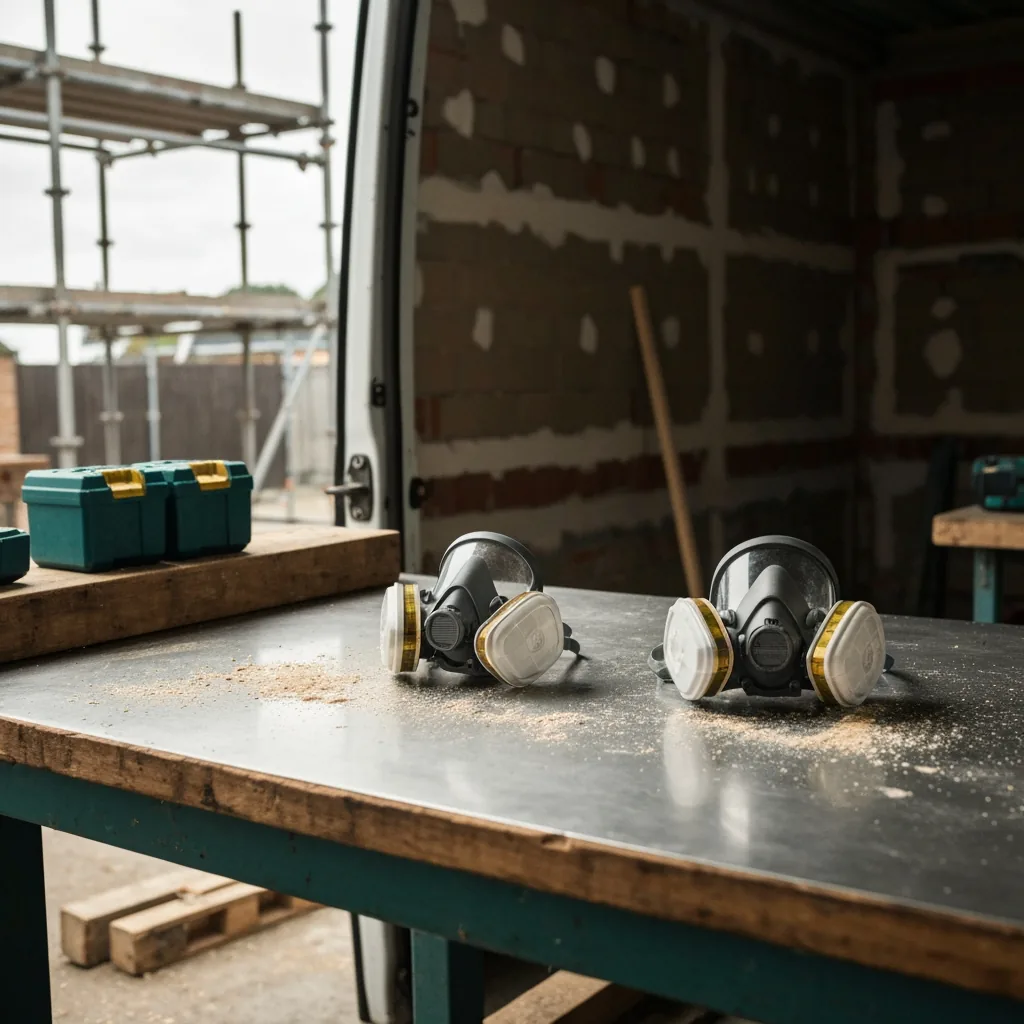
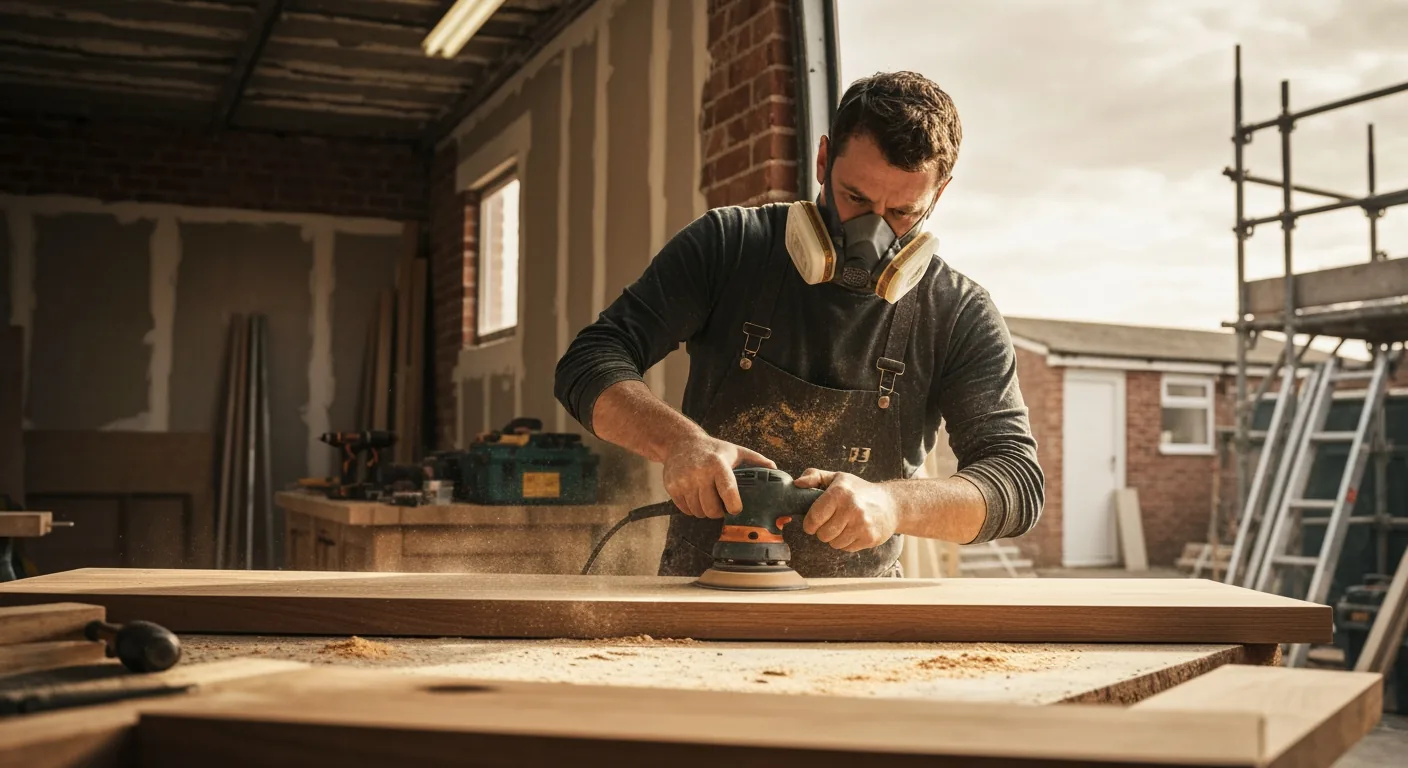
The trade-tested combination for sustained wood and MDF sanding is a Torxup CoreMask reusable half-mask fitted with FlowCore P3 cartridges, paired with H-class dust extraction at the sander. The CoreMask's TPE seal compresses around the cheek and bridge in a way no shaped cellulose disposable matches. The FlowCore filters trap particulate down to 0.3 microns and last roughly 20–40 hours of active dust exposure before pressure drop signals replacement. For occasional one-board jobs a certified FFP3 disposable is acceptable; for sustained sanding the reusable wins on seal, ongoing cost and waste. The full Torxup CoreMask product page details the housing system, and the MDF dust HSE explainer covers the carcinogen detail.
Plaster, Filler and Joint-Compound Sanding
Sanding plaster, filler or jointing compound demands P3 or FFP3 protection because the fines contain crystalline silica — silica exposure cumulatively drives silicosis, an irreversible lung condition that HSE places under the strictest control hierarchy under COSHH for the construction industry.
Plaster sanding produces a fine white dust that looks innocuous but contains respirable crystalline silica from gypsum and aggregate fines. The dust hangs in the air longer than wood dust because the particles are smaller and denser, which prolongs exposure long after sanding finishes. UK plasterers and decorators sanding skim coats, fill, sand and prime cycles routinely produce breathing-zone silica readings well above HSE's 0.1 mg/m³ exposure limit. A P3 reusable half-mask handles the load comfortably; the Torxup CoreMask paired with FlowCore filters keeps the wearer protected through full-day decoration work. The Torxup workshop mask guide for plaster and tile dust details the workflow, and the HSE COSHH framework sets the regulatory floor.
Paint and Primer Sanding
Sanding old paint or primer demands P3 protection plus organic-vapour cartridges if the paint contains solvent residue or any pre-1992 lead-pigment risk — wet sanding is preferred where practical, and any pre-1980s paintwork should be treated as potential lead until proven otherwise.
Paint sanding is the trickiest material because the hazard depends on what is in the paint. Modern water-based emulsions and acrylic primers produce particulate alone, where a P3 mask suffices. Older oil-based primers, alkyd undercoats and wood-stain finishes routinely contain solvent residue that releases as vapour during sanding heat, requiring a combined particulate-and-organic-vapour cartridge. Pre-1980s paintwork in UK homes can contain lead pigment, which under HSE guidance demands wet sanding plus a P3-class respirator at minimum and full lead-paint procedures if confirmed. The Torxup CoreMask paired with the ProDefend organic-vapour cartridge handles the combined hazard, and the Torxup painter's mask guide details the cartridge swap procedure.
Fit-Testing and Why Seal Beats Class
The single most important fact about respirator selection is that an unfit-tested mask delivers a fraction of its rated protection regardless of class — fit-testing and a reliable seal beat filter class on every metric, which is why the HSE mandates fit-testing for any RPE used in commercial trade work.
The seal physics is brutal. A P3 cartridge filtering at 99% on the laboratory bench delivers maybe 10–15% of that protection on a face it does not seal against, because the breath simply bypasses the filter through the gaps. A properly fit-tested P3 reusable half-mask delivers the full 99%. UK HSE fit-testing involves either qualitative testing using saccharin or Bitrex aerosol or quantitative testing using a particle-counting machine. Both methods take ten minutes per worker and are repeated annually. Fit-testing is mandatory for trade users; refer to the HSE fit-testing basics page for the full procedure. The Torxup CoreMask is engineered specifically to seal across a wide range of face geometries.
Frequently Asked Questions
Do I need a respirator for sanding?
Yes. Any sanding beyond a single small board needs respiratory protective equipment under UK HSE COSHH guidance. The legal minimum is a P3-class half-mask respirator or an FFP3 disposable filtering facepiece for hardwood, MDF and plaster work.
What mask should I wear for wood sanding?
For hardwood and MDF sanding, wear a P3-class reusable half-mask such as the Torxup CoreMask with FlowCore P3 filters, or a certified FFP3 disposable for occasional jobs. Light softwood sanding in well-ventilated conditions can sit at FFP2.
Is FFP2 enough for sanding?
FFP2 is acceptable for light softwood sanding in well-ventilated conditions. It is not adequate for hardwood, MDF, plaster or paint sanding, all of which demand P3 or FFP3 protection under HSE COSHH guidance.
Do I need a respirator for plaster sanding?
Yes. Plaster, filler and joint-compound sanding produces respirable crystalline silica which cumulatively drives silicosis. Wear a P3-class reusable half-mask or an FFP3 disposable, ideally combined with on-tool dust extraction.
What mask is best for sanding paint?
For modern emulsion and acrylic paint, a P3 or FFP3 mask suffices. For older oil-based, alkyd or pre-1992 paintwork containing solvent or potential lead residue, use a P3 plus organic-vapour cartridge such as the Torxup CoreMask with the ProDefend system.
How often should I replace my sanding respirator?
Disposable FFP3 facepieces should be replaced after each shift or sooner if breathing resistance climbs. Reusable P3 cartridges typically last 20-40 hours of active dust exposure; replace once breathing resistance is noticeably higher.
Does a respirator need to be fit-tested?
Yes for trade users. UK HSE mandates fit-testing for any tight-fitting respiratory protective equipment used in commercial work. Fit-testing takes ten minutes per worker per year and ensures the mask delivers its rated protection.
Breathe clean. Work longer.
The Torxup CoreMask is the reusable half-face respirator built for UK sanding, MDF, plaster and spray work — dual-stage cotton + carbon, FlowCore + ProDefend filter system, 20–40 hour filter life.
View CoreMask →