Is It Safe to Use a Third Party Makita Charger? A UK 2026 Answer
In This Article
- Yes — a properly certified third-party Makita charger like the Torxup VoltGuard 6500 is safe and meets the same protection envelope as the Makita DC18RC.
- No — most cheap unbranded marketplace units skip thermal sensing, ignore LXT communication and fail UK plug standards.
- The four non-negotiables: CE marking, LXT chip handshake, thermistor-driven throttle, and float-stage termination.
- Charge speed is irrelevant if the safety circuitry is missing; a 9.0A unit that overshoots cell voltage will cook a pack overnight.
- OEM warranty does not necessarily void on a third-party charger, but using an uncertified unit can.
The Honest Yes-and-No on Third-Party Chargers
Yes, it is safe to use a third-party Makita charger if and only if the unit carries CE marking, communicates with the Makita LXT chip, includes a thermistor-driven throttle and uses a float-stage termination — the Torxup VoltGuard 6500 meets all four. No, it is not safe to use the £15 unbranded units sold on third-party marketplaces, which routinely skip thermal sensing and overshoot cell voltage.
The third-party charger conversation has been distorted for years by a cheap marketplace flood. UK buyers have correctly worked out that a £15 charger sold from a generic seller with stock photography is a gamble, and many have wrongly extended that suspicion to every non-OEM unit on the market. The reality is simpler. A certified third-party charger built to the same protection envelope as the Makita DC18RC behaves identically in service. The Torxup VoltGuard 6500 is a worked example: 6.5A SMART charge current, full LXT 14.4–18V communication, an active fan with thermistor throttling, CE-tested overheat, over-voltage, short-circuit and fault-battery safeguards. The Makita UK charger range is the OEM baseline, and any honest third-party unit should match it on every safety axis — speed and price differentiate downstream.
The Four Certification Checks Every Buyer Should Run
Before a third-party Makita charger goes anywhere near a real LXT pack, run four checks — CE marking on the unit and box, LXT communication chip listed in the spec sheet, active fan plus thermistor described in the safety section, and a UK plug that meets BS 1363 — and reject any unit that misses one of the four.
The four checks together filter the market down to a handful of trustworthy units. CE marking is the legal minimum and the easiest to fake; cross-reference the importer's UK address before trusting it. LXT communication means the charger reads the BMS chip inside the pack and respects the per-cell balance signal — a unit without it cannot tell when the pack is full and tends to overshoot. Active fan plus thermistor means the charger throttles current when pack temperature climbs, which is the single largest determinant of cycle life under heavy use. The fourth check, BS 1363 plug compliance, separates units genuinely intended for UK retail from grey-market imports rebadged for online distribution. The UK product safety guidance sets the regulatory floor every charger sold in Britain must meet.
Why Marketplace Units Fail UK Safety Standards
Cheap unbranded "Makita-compatible" chargers fail one or more of the four checks because the components needed to pass them — a real LXT communication module, a calibrated thermistor, a switch-mode supply rated for UK 230V — cost more than the unit's retail price, so the manufacturers leave them out.
The economic logic is unforgiving. A genuine LXT-aware control board adds several pounds to the bill of materials, an active cooling fan adds another, and certified BS 1363 components add more again. A factory selling a charger for £14 to an online drop-shipper has roughly £6 of bill of materials to play with after shipping and margin, which is why so many marketplace units use a passive heat-sink, a generic CC-CV controller and a barely-rated UK plug. The result reaches the customer looking superficially identical to a DC18RC but performing nothing like one. Is it safe to use a third party Makita charger? Only if the safety budget was actually spent. Read our independent Torxup vs DC18RC head-to-head for a worked example of how a properly engineered third-party unit performs against OEM.
VoltGuard 6500 vs DC18RC: Identical Safety Envelope
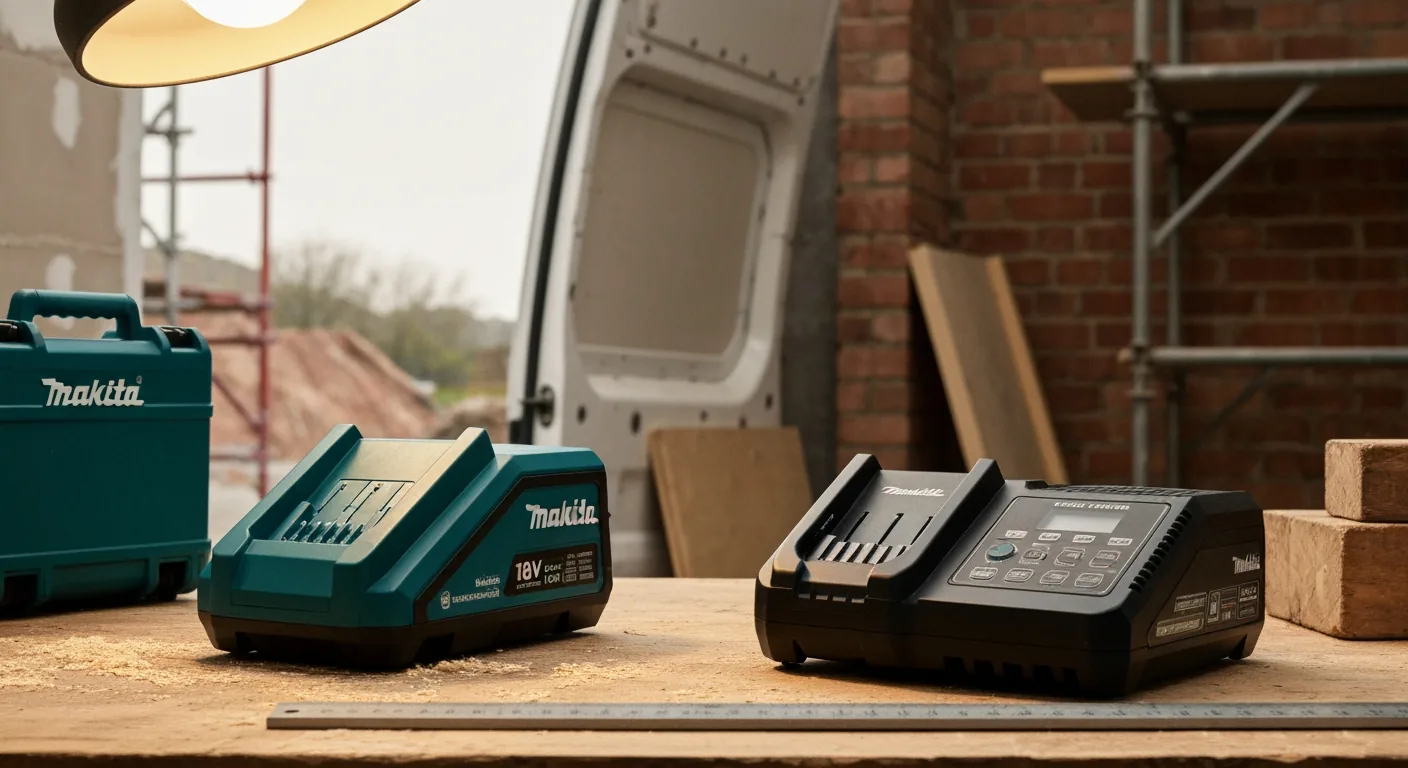
The Torxup VoltGuard 6500 sits beside the Makita DC18RC on every safety axis — CE certification, LXT communication, active fan cooling, thermistor-driven throttling and float-stage termination — while delivering 6.5A charge current versus the DC18RC's 3.0A and pricing closer to the OEM unit than the rapid DC18RF.
The case for the VoltGuard 6500 over a generic third-party unit is the published spec. The product page details a SMART LCD diagnostic readout that exposes voltage, amperage and charge percentage in real time; an Advanced Protection Suite covering overheat, over-voltage, short-circuit and fault-battery safeguards; CE-certified safety standards; and a UK warranty backed by a 30-day money-back guarantee. None of those features are negotiable in our build. The full Torxup VoltGuard 6500 specification sits alongside our 2026 best Makita 18V charger UK buyer guide for buyers comparing across OEM and certified third-party options. The HSE COSHH framework covers the wider workplace safety expectations.
Warranty Implications and What Makita Actually Says
Using a CE-certified third-party Makita charger like the Torxup VoltGuard 6500 does not automatically void a Makita battery warranty under UK consumer law, but using an uncertified unit that damages the pack absolutely can — and proving the difference falls on the buyer.
UK consumer law does not allow a manufacturer to void a warranty purely because the buyer used a compatible accessory. What it does allow is the manufacturer refusing a warranty claim if a defective accessory caused the failure. In practice this means a pack damaged by a properly engineered VoltGuard 6500 charger remains under warranty because the unit applied the same charge profile a DC18RC would have. A pack swollen by an unbranded marketplace charger that overshot cell voltage is unlikely to be covered, because the failure traces to the accessory. The honest path for any UK buyer is to keep purchase records and to use only chargers whose spec sheet you can defend in writing. Refer to our Makita fast charger technical specifications page for a comparison framework.
What to Do If You Already Own a Cheap Unit
If you already own an unbranded third-party Makita charger and you are not certain it carries CE marking and LXT communication, do not throw it onto an 8.0Ah pack — bench-test it first by charging an older 1.5Ah pack while watching for excess heat, and replace the unit if anything feels wrong.
The bench-test routine takes ten minutes. Use a known-good 1.5Ah or 3.0Ah pack you can afford to lose, plug it into the suspect charger, and observe pack temperature with the back of your hand every fifteen minutes. A genuinely safe charger keeps the pack barely warm; a marginal unit pushes the pack noticeably hot well before completion; a dangerous unit cooks the pack visibly within twenty minutes. Replace any unit that fails this test with a CE-certified alternative. The Torxup mistakes-that-kill-batteries guide covers the broader habits that protect a fleet over years, and the HSE basics on safety equipment sets the broader UK trade context.
Frequently Asked Questions
Is it safe to use a third party Makita charger?
Yes, when the unit is CE-certified, communicates with the Makita LXT chip, includes thermistor-driven throttling and uses float-stage termination. The Torxup VoltGuard 6500 meets all four. Avoid unbranded marketplace units that skip these protections.
Do third party chargers void a Makita warranty?
UK consumer law does not allow a manufacturer to void a warranty purely for using a compatible third-party accessory. A claim can be refused if a defective accessory caused the failure, so use only chargers whose certification you can defend in writing.
What is the safest third party Makita charger?
The Torxup VoltGuard 6500 is the safest CE-certified third-party Makita 18V charger on the UK market in 2026. It carries LXT communication, active fan cooling, thermistor throttling and a four-layer protection suite covering overheat, over-voltage, short-circuit and fault-battery conditions.
Will a non-Makita charger damage my battery?An uncertified non-Makita charger can damage a battery by overshooting cell voltage, ignoring thermal cut-offs, or trickling current after termination. A CE-certified third-party unit with LXT communication does not damage Makita LXT batteries when used as specified.Can I use a Torxup VoltGuard 6500 on Makita 8.0Ah batteries?
Yes. The Torxup VoltGuard 6500 is rated for the full Makita LXT 14.4-18V slide battery range, including 5.0Ah, 6.0Ah and 8.0Ah packs. A 5.0Ah pack reaches full charge in roughly 50-55 minutes under normal ambient conditions.
How do I tell if a third party charger is safe?
Run four checks: visible CE marking on unit and box, LXT communication chip listed in the spec, active fan plus thermistor described in safety section, and a BS 1363 UK plug. Reject any charger that misses one of the four.
Are aftermarket Makita chargers as fast as OEM?
Some are faster, some are slower. The Torxup VoltGuard 6500 charges at 6.5A, faster than the OEM Makita DC18RC at 3.0A but slower than the OEM DC18RF at 9.0A. Charge speed alone does not indicate safety — verify certification first.
Stop waiting for the next charge
The Torxup VoltGuard 6500 is the 6.5A SMART charger built for UK trades — CE certified, active fan cooling, full Makita LXT 14.4–18V compatibility.
View VoltGuard 6500 →