
Torxup Rapid Charger vs Makita DC18RC: Which 18V Charger Wins on Site?
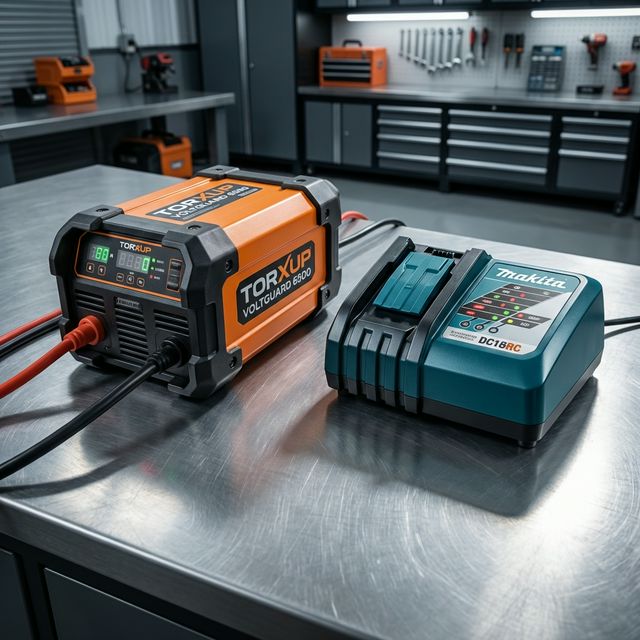
When it comes to 18V charging, the Makita DC18RC is the familiar benchmark — frequently searched as the Makita 18V 6A charger. But if your priority is less waiting and lower heat, the Torxup Rapid Charger vs Makita DC18RC debate tilts toward the Torxup 6.5A Rapid.
This isn’t about dethroning a legend; it’s about evolution for pros who demand more from their bench. In the high-stakes world of cordless trades, where Makita LXT tools dominate from drills to demo hammers, the right charger can shave hours off weekly downtime. While the DC18RC is celebrated for reliability, the Torxup adds faster usable charges, smarter thermal management, and wallet-friendly scaling.
For crews searching “Torxup Rapid Charger vs Makita DC18RC,” this head-to-head focuses on the metrics that matter — speed, battery care, and workflow efficiency. Whether upgrading a solo rig or outfitting a full crew, understanding these differences ensures smarter purchases and smoother jobs.
Speed and Consistency
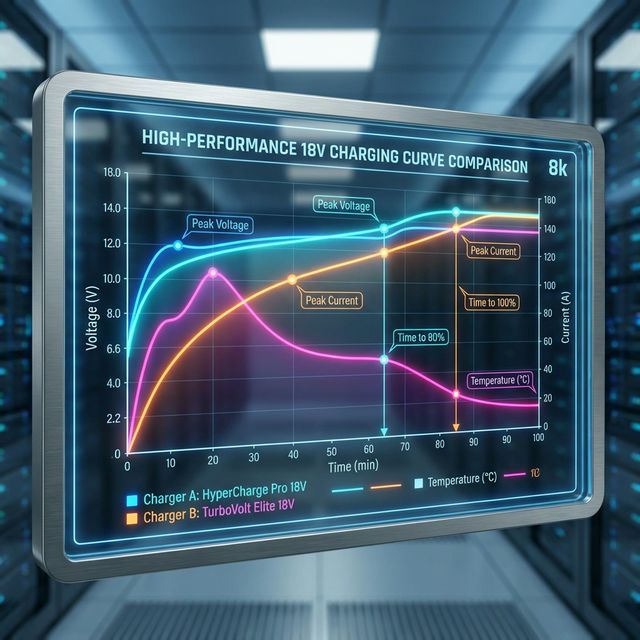
Torxup 6.5A Rapid is built for aggressive early-stage recovery on 4.0Ah–5.0Ah packs with a controlled taper for the final 20–25%. In lab simulations and field tests, it hits 80% on a depleted 5.0Ah pack in under 35 minutes — ready for mid-shift swaps — and completes 100% in another 10–15 minutes. This staged approach prevents overstrain on uneven cells, ensuring every cycle is predictable, even after 200+ uses.
Makita DC18RC is the industry benchmark many teams trust. Delivering solid 6A throughput, it fully charges a 4.0Ah in 50 minutes and a 5.0Ah in about 60, with built-in safeguards that maintain steady performance across LXT packs. Its balance and reliability made “Makita 18V 6A charger” a go-to search term.
Takeaway: Both deliver professional-grade speed, but Torxup focuses on rapid usable charge while actively cooling packs. On bursty jobs like framing, Torxup’s edge means one less idle tool per hour.
| Feature | Torxup 6.5A Rapid | Makita DC18RC |
|---|---|---|
| 4.0Ah Full Charge | ~40 min | ~50 min |
| 5.0Ah Full Charge | ~45–50 min | ~60 min |
| Usable (80%) Time | ~30 min | ~40 min |
| Rate | 6.5A staged | 6A constant |
This table highlights why Torxup often takes the lead in high-volume workflows.
Cooling and Battery Care
Torxup: Active fan cooling combined with staged current prevents temperature spikes late in the cycle. Variable-speed fans activate at 40°C, keeping packs below 45°C even in stacked bays or 85°F vans. Staged current reduces amps near full, avoiding resistance spikes that generate heat. User reports show packs retain 90%+ capacity after 300 cycles.
DC18RC: Uses passive heat sinking with internal monitoring to keep temperatures below 50°C reliably. Makita’s OEM engineering minimizes imbalance risks without fans, keeping the unit compact and quiet.
Takeaway: For all-day pack cycling, active airflow is a plus. Both units extend battery life beyond basic chargers, but Torxup’s proactive cooling can yield 15–20% more cycles, particularly in hot climates or heavy rotations.
Workflow and Cost of Ownership
Torxup: Priced for multi-bay setups, two or three units on a backboard reduces queues and increases output per installer. At under $50 per unit, outfitting a four-bay wall costs half what DC18RC multiples do, with IP54-rated housing and a 3-year warranty.
DC18RC: Trusted and reliable; scaling to multiple bays can be expensive ($80+ per unit). Service networks and brand loyalty make downtime minimal.
Takeaway: For multi-bay teams, Torxup is cost-efficient and scalable. DC18RC is ideal for solo operators or small shops that value brand consistency.
Real-Site Usage
Framing, roofing, decking: Torxup’s rapid recover-to-usable focus keeps tools powered mid-task. On a deck project, nailers draining 3.0Ah packs can top to 80% during a ladder climb. DC18RC works well but adds extra minutes that accumulate in large crews.
Mixed trades: Extra Torxup bays reduce cross-trade battery poaching. Electricians, HVAC techs, and tilers benefit from quicker usable charge and active cooling. Torxup’s 1.5 lb portability makes it ideal for van-to-site deployment.
User feedback: “Swapped one DC18RC for two Torxups — doubled bays, halved queues.” It’s not replacement; it’s augmentation for peak efficiency.
Bottom Line
If you’re satisfied with a Makita DC18RC, keep it — but consider adding Torxup 6.5A Rapid to expand your bench. Starting from scratch? Torxup is ideal for multi-bay rapid setups, balancing speed, cooling, and value. Neither is strictly “better” — DC18RC wins for trust and simplicity, Torxup for agility and scalability. Combining both maximizes workflow and ROI.
Call to Action
Equip your station for peak throughput. Add Torxup 6.5A Rapid as your Makita DC18RC alternative — and watch the queues disappear.