
What Does FFP3 Mean? The EN 149 Standard Explained for UK Trades
In This Article
- FFP3 stands for Filtering Facepiece class 3 under European Norm EN 149, capable of filtering at least 99% of airborne particulate.
- FFP1, FFP2 and FFP3 are not interchangeable — each is a distinct protection class with its own filtration threshold.
- FFP3 (EN 149) and P3 (EN 143) deliver equivalent particulate protection levels, just on different mask types.
- The 99% rating is a laboratory ceiling — real-world performance depends entirely on seal fit to the wearer's face.
- FFP3 is the legal minimum for hardwood, MDF, plaster, silica and lead-paint sanding under UK HSE COSHH guidance.
What FFP3 Actually Means
FFP3 stands for Filtering Facepiece class 3 under European Norm EN 149, the highest particulate filtration class for disposable filtering facepieces sold in the UK and EU. The 99% rating means the facepiece must filter out at least 99% of airborne particulate down to 0.6 micron when tested under the EN 149 protocol — the same filtration ceiling as the P3 cartridge classification under EN 143 used in reusable half-masks. FFP3 is the UK legal minimum for hardwood, MDF, plaster, silica and lead-paint dust exposure under HSE COSHH guidance.
The acronym breaks down literally. FF stands for Filtering Facepiece — meaning a single-use, shaped fabric mask covering the nose and mouth. P stands for Particulate — meaning the rating addresses solid airborne particles, not gases or vapours. The number sits at 1, 2 or 3 representing the protection class, with 3 being the strictest. EN 149 is the European standard published originally in 2001 with revisions through 2009, governing test methodology, performance thresholds and labelling rules for filtering facepieces sold across the UK and EU. Anything labelled FFP3 must demonstrate compliance with that standard via accredited laboratory testing. The HSE RPE guidance hub documents the regulatory framework.
The EN 149 Test Method in Plain English
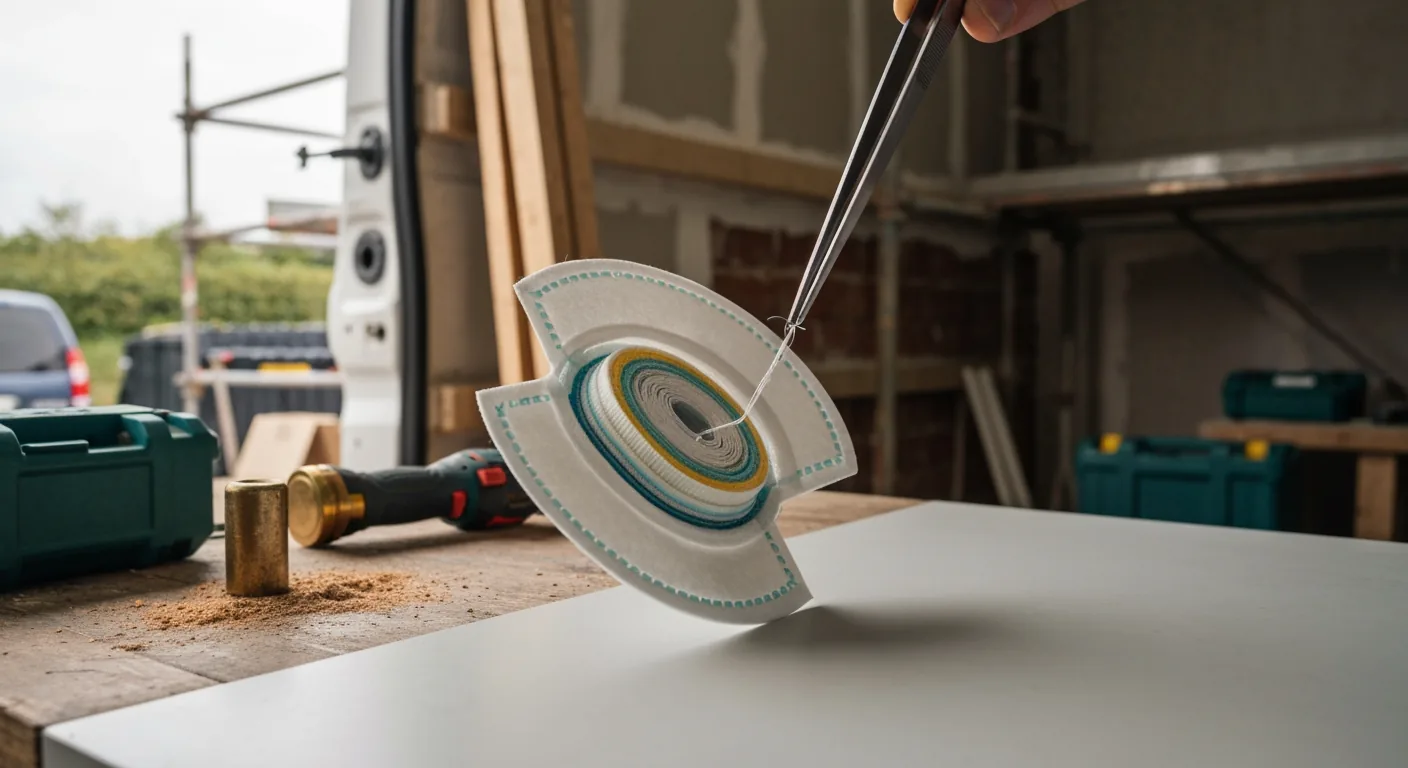
The EN 149 test method runs aerosolised particulate — sodium chloride at 0.6 micron and paraffin oil at 0.4 micron — through the facepiece while measuring percentage filtration, then runs a separate test loading the mask cumulatively to certify performance after extended use; FFP3 must hold filtration at 99% or above through both initial and loaded conditions.
The test sequence matters because it filters out marketing-grade masks that look fine on day one but fail under accumulated dust load. EN 149 requires the facepiece to maintain 99% filtration after loading equivalent to typical full-shift exposure, after simulated breathing at multiple flow rates, and across a temperature range covering UK working conditions. The "R" suffix on FFP3 R indicates the mask is rated for reuse across multiple shifts; the "NR" suffix indicates non-reusable single-shift use. Most FFP3 disposables sold in UK trade outlets are NR rated, designed for one-shift use and discarded. The full Torxup dust mask technical specifications walks through the testing relevant to reusable masks.
FFP1 vs FFP2 vs FFP3: The Real Differences
FFP1 filters at least 80% of particulate, FFP2 filters at least 94%, and FFP3 filters at least 99% under EN 149 — the gap between FFP2 and FFP3 looks small on paper at five percentage points, but in cumulative exposure terms FFP3 admits roughly 17% of the contaminant FFP2 admits, which is the difference between safe and unsafe for hardwood and silica work.
The arithmetic compounds. An FFP2 mask working at its 94% threshold admits 6% of inhaled particulate; an FFP3 mask at 99% admits 1%. Across an eight-hour shift breathing 10 m³ of air with 5 mg/m³ ambient dust, the FFP2 wearer accumulates 3 mg of dust in the lung over the shift; the FFP3 wearer accumulates 0.5 mg. Across a working year that is the difference between exceeding HSE silica exposure limits and staying comfortably below them. FFP1 at 80% is genuinely a nuisance rating — adequate for pollen and very light cleaning dust, inadequate for any UK trade work. The full Torxup 2026 dust mask buyer's guide sets the broader trade context.
FFP3 vs P3 Cartridges
FFP3 (EN 149) and P3 (EN 143) are two standards covering the same particulate protection level on different mask types — FFP3 covers shaped disposable filtering facepieces, P3 covers replaceable cartridges fitted to reusable half-masks; both filter at least 99% of particulate down to 0.6 micron at the laboratory bench.
The interchangeability rule is simple. For protection class purposes, FFP3 disposable and P3 cartridge are equivalent — a UK trade decision between the two is workflow, not protection level. P3 cartridges fitted to a reusable half-mask deliver the same filtration as FFP3 disposables on the laboratory test, with the practical advantages of better seal geometry, lower per-hour cost across multiple shifts, and reduced waste. The Torxup CoreMask reusable system fitted with FlowCore P3 cartridges sits at the EN 143 P3 protection level, meeting all UK HSE COSHH requirements for hardwood, MDF, plaster and silica work. The Torxup CoreMask product page details the full housing system.
When FFP3 Is Mandatory in UK Trade
UK HSE COSHH guidance treats FFP3 or P3 protection as the legal minimum for any work involving hardwood dust, MDF dust, respirable crystalline silica, lead-paint dust, fibreglass particulate, asbestos-related work and any substance the Workplace Exposure Limit framework places under the strictest control hierarchy.
The mandatory list is broader than most UK tradesmen realise. Hardwood and MDF sanding, cutting and routing — FFP3 minimum because the dust is a Group 1 carcinogen. Plaster sanding, dry-cutting concrete or masonry — FFP3 minimum because of crystalline silica. Sanding pre-1992 paintwork — FFP3 minimum because of potential lead pigment. Cutting fibre-cement board, removing acoustic ceiling tiles, working around damaged plasterboard with potential mould, handling fibreglass insulation — all FFP3 territory under HSE guidance. The number of UK trade tasks that legitimately call for FFP3 is large; standardising on a P3 reusable half-mask sidesteps the daily decision. Refer to the HSE COSHH framework for the full hazard list and our dust mask technical specs for testing detail.
Fit, Seal and Real-World Protection
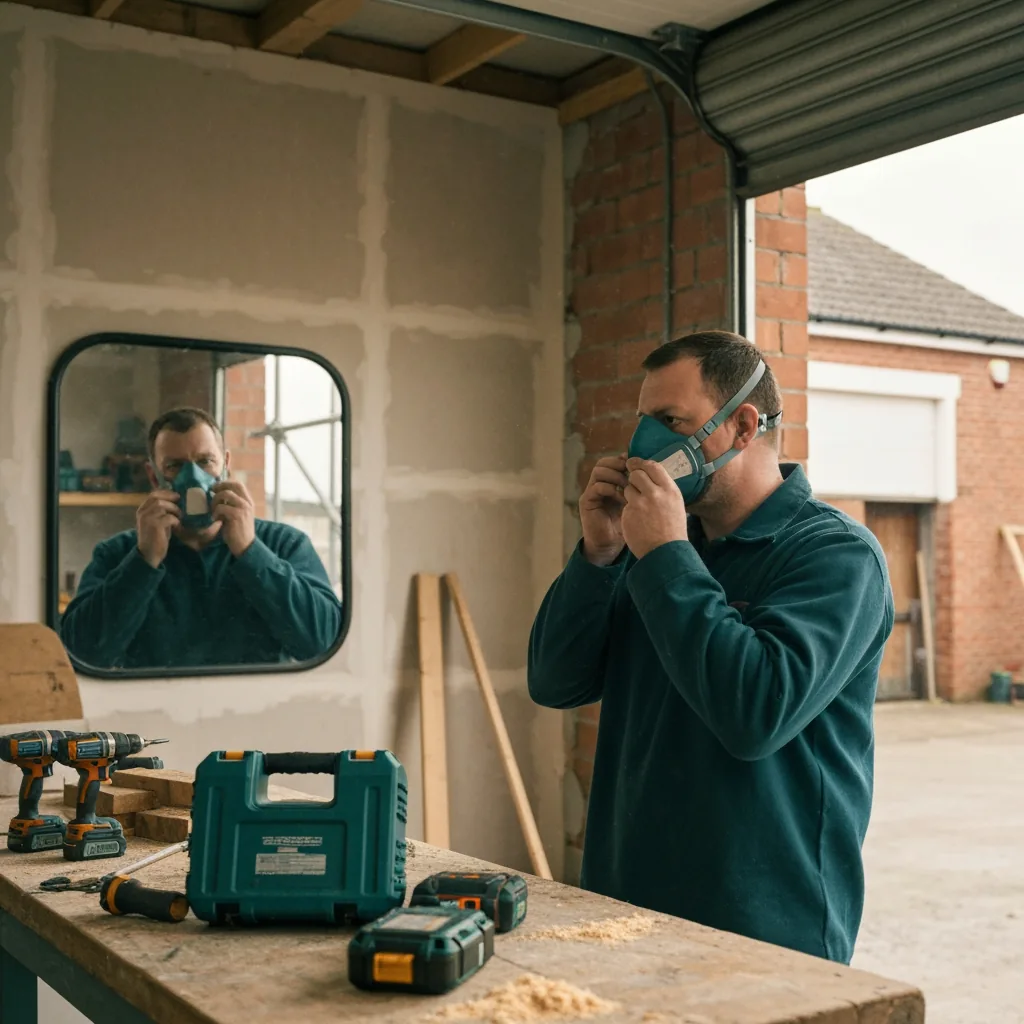
An FFP3 mask delivers its 99% rating only when the seal against the wearer's face is intact — without fit-testing the protection drops to a fraction of the laboratory rating, which is why HSE mandates fit-testing for trade users and why a properly fit-tested FFP2 can sometimes outperform a poorly-fitted FFP3 in real conditions.
The seal is the single largest determinant of real-world performance. A 99% filter sitting on a face it does not seal against allows breath to bypass the filter through gaps, dropping effective protection to perhaps 50–70% regardless of label. The HSE-mandated fit-test takes ten minutes per worker and uses either a saccharin or Bitrex aerosol the wearer should not be able to taste, or a quantitative particle-counting machine. Pass the test and the mask delivers its rating; fail the test and the mask is the wrong shape for your face. UK HSE requires fit-testing annually for any trade user. The HSE fit-testing basics page documents the procedure.
Frequently Asked Questions
What does FFP3 mean?
FFP3 stands for Filtering Facepiece class 3 under European Norm EN 149. It is the highest particulate filtration class for disposable filtering facepieces and removes a minimum of 99% of airborne particulate down to 0.6 micron.
What is the difference between FFP1, FFP2 and FFP3?
FFP1 filters at least 80%, FFP2 filters at least 94%, and FFP3 filters at least 99% of airborne particulate under EN 149. FFP3 is the UK legal minimum for hardwood, MDF, plaster and silica work; FFP1 is a nuisance rating only.
Is FFP3 better than P3?
FFP3 and P3 deliver equivalent particulate protection — both filter at least 99% of particulate down to 0.6 micron. FFP3 covers disposable filtering facepieces under EN 149; P3 covers replaceable cartridges under EN 143. Choose the format that suits your workflow.
Is FFP3 the same as N99?
FFP3 (European EN 149) and N99 (American NIOSH) are roughly equivalent in filtration percentage but use different test methods. UK and EU trade users should specify FFP3 or P3 to ensure compliance with HSE COSHH and EN 149 requirements.
What is FFP3 used for?
FFP3 is used for protection against hardwood dust, MDF dust, respirable crystalline silica, plaster fines, lead-paint particulate, fibreglass and other Group 1 hazardous airborne contaminants. It is the UK legal minimum for any work in those material categories.
Can I reuse an FFP3 mask?
FFP3 masks labelled "R" are reusable across multiple shifts; masks labelled "NR" are non-reusable single-shift use. Most FFP3 disposables sold in UK trade outlets are NR rated. For sustained reuse, a P3-class reusable half-mask such as the Torxup CoreMask is the better choice.
How long does an FFP3 mask last?
An FFP3 NR disposable lasts one working shift or up to eight hours of active dust exposure. Replace immediately if breathing resistance climbs, the mask becomes contaminated, or the seal fails. Reusable P3 cartridges last 20-40 hours of dust exposure.
Breathe clean. Work longer.
The Torxup CoreMask is the reusable half-face respirator built for UK sanding, MDF, plaster and spray work — dual-stage cotton + carbon, FlowCore + ProDefend filter system, 20–40 hour filter life.
View CoreMask →