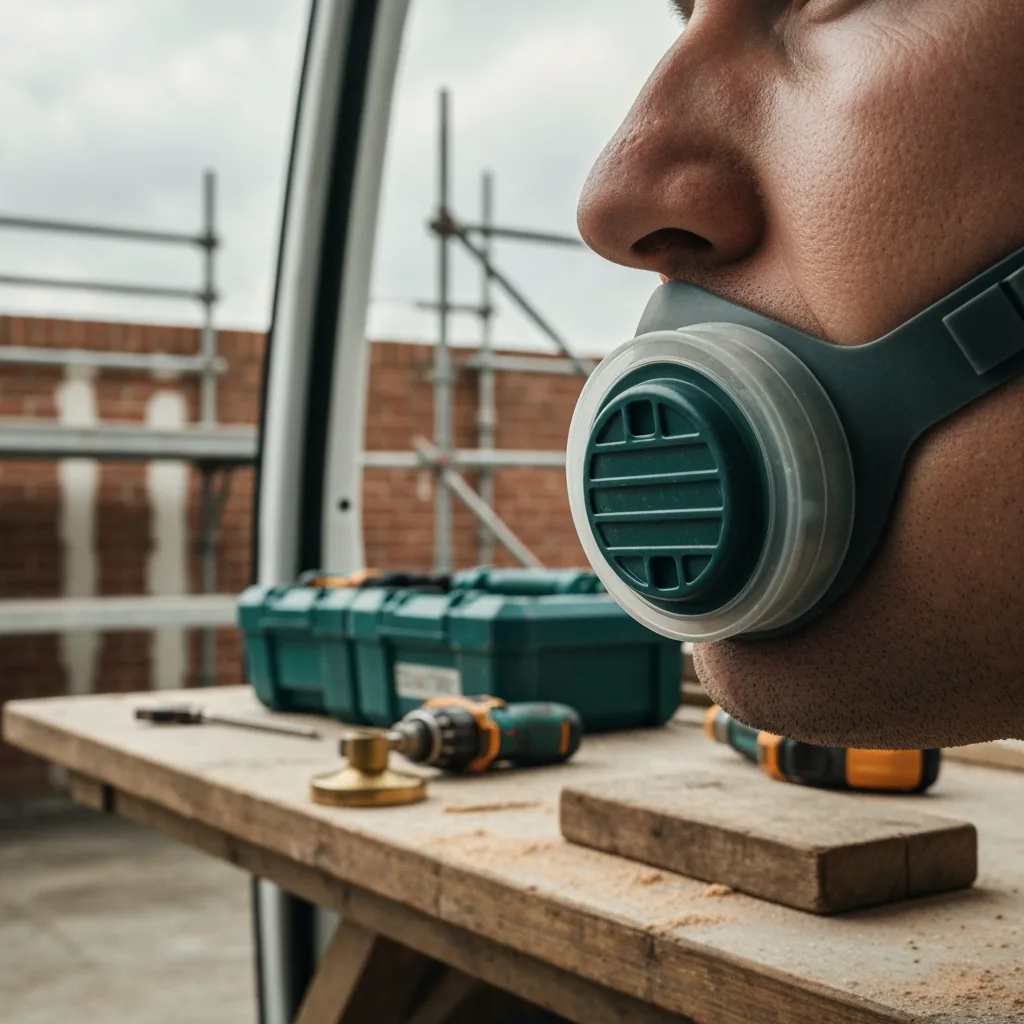

Why Do Dust Masks Fog Glasses? The Mechanical Fix for UK Tradesmen
In This Article
- Dust masks fog glasses because warm exhaled breath escapes upward over the bridge of the nose where the seal is failing.
- Anti-fog sprays treat the symptom (lens condensation) without fixing the cause (a leaky upper seal).
- The mechanical fix is mask geometry — a low-bridge TPE seal that sits below the glasses frame and channels breath sideways.
- The Torxup CoreMask is engineered specifically with this seal geometry; UK glasses-wearing trade users are the design target.
- Disposable FFP3 masks routinely fail this geometry because the metal nose clip rarely seals against varied face shapes.
Why Fogging Actually Happens
Dust masks fog glasses because warm exhaled breath at roughly 35°C and 95% relative humidity escapes upward over the bridge of the nose where the mask seal is failing — that warm humid air hits cooler glasses lenses sitting at ambient site temperature and condenses immediately into a fog film. Fogging is not a glasses problem; it is a mask seal problem. Fix the seal and the fogging disappears permanently.
The physics is simple. Exhaled human breath leaves the lungs at body temperature and saturated with moisture from the lung lining. On a typical UK working site at 18–22°C ambient, the gap between exhaled breath temperature and lens temperature is large enough that any warm breath touching the lens condenses instantly. A sealed mask routes that breath sideways and downward through the exhalation valve and around the cheek, well below glasses lens height. A failing mask routes a portion of that breath upward through gaps in the upper seal, straight at the lenses. Diagnose the leak; do not chase the condensation. The full Torxup 2026 dust mask buyer's guide covers the broader mask context.
Why Anti-Fog Sprays Are a Symptom Treatment
Anti-fog sprays applied to glasses lenses change how moisture beads on the lens surface, spreading micro-droplets into a thin uniform film instead of localised fog patches — but the underlying breath leak through the upper mask seal continues, the lens still receives warm humid air, and the spray's effect typically lasts 15–30 minutes before reapplication is needed.
The trade-test is unforgiving. A UK joiner applies anti-fog spray to safety glasses in the morning, fits a disposable FFP3, starts cutting MDF; for the first half-hour the lenses stay clear, then the spray's surfactant film breaks down under continuous breath flux and fogging returns. The spray does not address the breath leak; it only changes how condensation appears. Another spray application buys another half-hour. Across an eight-hour shift the user spends a meaningful percentage of the day re-applying spray and wiping lenses. The mechanical fix solves the problem in seconds. Refer to our existing CoreMask anti-fog strategy guide for the field routine.
The Mechanical Fix: Seal Geometry
The mechanical fix for dust mask glasses fogging is a mask with seal geometry that sits below the glasses frame on the cheek and bridges the nose without crowding the lens line — meaning the upper seal compresses against the lower bridge cartilage rather than the upper bridge bone, channeling all exhaled breath sideways through the cheek seal and downward through the exhalation valve.
The geometry rule is concrete. The mask's upper seal needs to terminate below where the glasses' lower frame rim sits on the face. Most UK adult faces sit the lower frame rim about 12–18mm above the alar crease (the line where the nostril joins the cheek). A mask seal terminating below that line stays clear of the glasses entirely; a mask seal terminating above that line either pushes the glasses up or leaves a gap that breath escapes through. The Torxup CoreMask's TPE upper seal is engineered to terminate below typical glasses frame position on UK adult face geometry. The 3M 7502's seal sits higher; the GVS Elipse sits closer but not as low as the CoreMask. The Torxup CoreMask product page documents the seal geometry.
Why Disposable FFP3s Routinely Fog
Disposable FFP3 facepieces routinely fail the glasses-fogging test because the metal nose clip — designed to be bent over the bridge of the nose to create a seal — rarely conforms cleanly to varied face shapes, leaves micro-gaps along its length, and loses tension within an hour of warm work.
The mechanical limitation is structural. A shaped cellulose disposable mask carries a thin aluminium strip across the bridge of the nose, intended to be hand-bent into shape on first fit. The strip is flexible enough to bend but not strong enough to maintain compression across an eight-hour shift, especially against the constant micro-movements of facial muscles during work. Within the first hour the metal loses its shape, gaps reopen along its length, and breath leaks out continuously. Repeated bending only weakens the strip further. The cellulose body softens with sweat, accelerating the decay. Disposable FFP3s remain perfectly adequate for the protection class but are inherently poor at glasses-fogging avoidance. Refer to our anti-fog CoreMask guide for glasses wearers for the comparative detail.
How the Torxup CoreMask Solves It
The Torxup CoreMask reusable half-mask solves the glasses fogging problem through three combined design choices — a TPE upper seal that compresses around the lower bridge cartilage rather than the upper bone, a downward-and-outward exhalation valve that channels breath away from the lens line, and a balanced strap design that holds compression consistently across the full work shift.
Each design element earns its place. The TPE compound used in the CoreMask seal is firmer than the cellulose used in disposables but softer than rubber, allowing the material to compress against varied face shapes while maintaining tension across a full shift. The seal terminates below typical UK glasses frame position. The exhalation valve sits low on the centre of the mask body, venting downward and outward — well below lens height and never toward the eyes. The four-point strap design distributes head pressure evenly so the mask does not slip during sustained work. Combined, the three elements deliver consistent fog-free performance for UK glasses-wearing tradesmen across full eight-hour shifts. The Torxup CoreMask technical specs page documents the engineering, and the HSE RPE guidance sets the wider compliance position.
Field Routine for Glasses Wearers
The field routine for UK glasses-wearing tradesmen using the Torxup CoreMask is straightforward — fit the mask first, settle the upper TPE seal against the lower bridge, then fit the glasses on top of the seal with the lower frame rim sitting on cheek bone above the seal — that ordering puts the seal below the glasses and prevents any upward breath escape from day one.
The two-step ordering matters. Glasses fitted first then mask second pushes the lower glasses frame rim onto or under the upper mask seal, creating gaps. Mask fitted first with the upper seal settled cleanly, then glasses fitted second on top of the seal, places the lens line clear of breath path. Five minutes of practice gets the routine into muscle memory. Combined with the CoreMask's seal geometry, fogging stops being part of the working day. UK glasses wearers running through MDF, plaster and primer work routinely report zero spray application across full shifts after switching to this combination. The Torxup anti-fog strategies guide covers the field tips and the HSE COSHH framework the wider context.
Frequently Asked Questions
Why do dust masks fog up glasses?
Dust masks fog glasses because warm exhaled breath escapes upward over the bridge of the nose where the mask seal is failing. The warm humid air hits cooler glasses lenses and condenses immediately. Fogging is a mask seal problem, not a glasses problem.
How do I stop my dust mask fogging up my glasses?
Use a mask with TPE seal geometry that terminates below the glasses frame line, fit the mask first then the glasses on top of the seal, and ensure the exhalation valve points downward and outward. Anti-fog sprays treat symptoms; mask geometry solves the cause.
Does anti-fog spray work on safety glasses?
Anti-fog spray works for 15-30 minutes by changing how moisture condenses on the lens surface. It does not stop the underlying breath leak through the failing mask seal, so reapplication is needed every half-hour throughout the shift.
Why does my FFP3 disposable mask fog my glasses?
Disposable FFP3 masks fog glasses because the aluminium nose clip cannot maintain a clean seal across varied face shapes, leaves micro-gaps along its length, and loses tension within an hour of warm work. Disposable shape and material limit fog-free performance.
Is the Torxup CoreMask good for glasses wearers?
Yes. The Torxup CoreMask is engineered specifically for UK glasses-wearing tradesmen with a TPE upper seal that terminates below typical glasses frame position, a downward-and-outward exhalation valve, and a four-point strap design that holds compression across full shifts.
Can I wear glasses under a half-mask respirator?
Yes, glasses are worn over a properly fitted half-mask respirator with the upper mask seal sitting below the glasses frame line. The Torxup CoreMask seal geometry is specifically designed to work with prescription glasses and safety glasses worn together.
Will fit-testing improve glasses fogging?Fit-testing confirms that the mask seals against the wearer's face, which directly addresses the upper seal leak that causes glasses fogging. UK HSE mandates fit-testing for trade users; pass the test and breath stays inside the mask, not heading toward the lenses.Breathe clean. Work longer.
The Torxup CoreMask is the reusable half-face respirator built for UK sanding, MDF, plaster and spray work — dual-stage cotton + carbon, FlowCore + ProDefend filter system, 20–40 hour filter life.
View CoreMask →
Breathe clean. Work longer.
The Torxup CoreMask is the reusable half-face respirator built for UK sanding, MDF, plaster and spray work — dual-stage cotton + carbon, FlowCore + ProDefend filter system, 20–40 hour filter life.
View CoreMask →