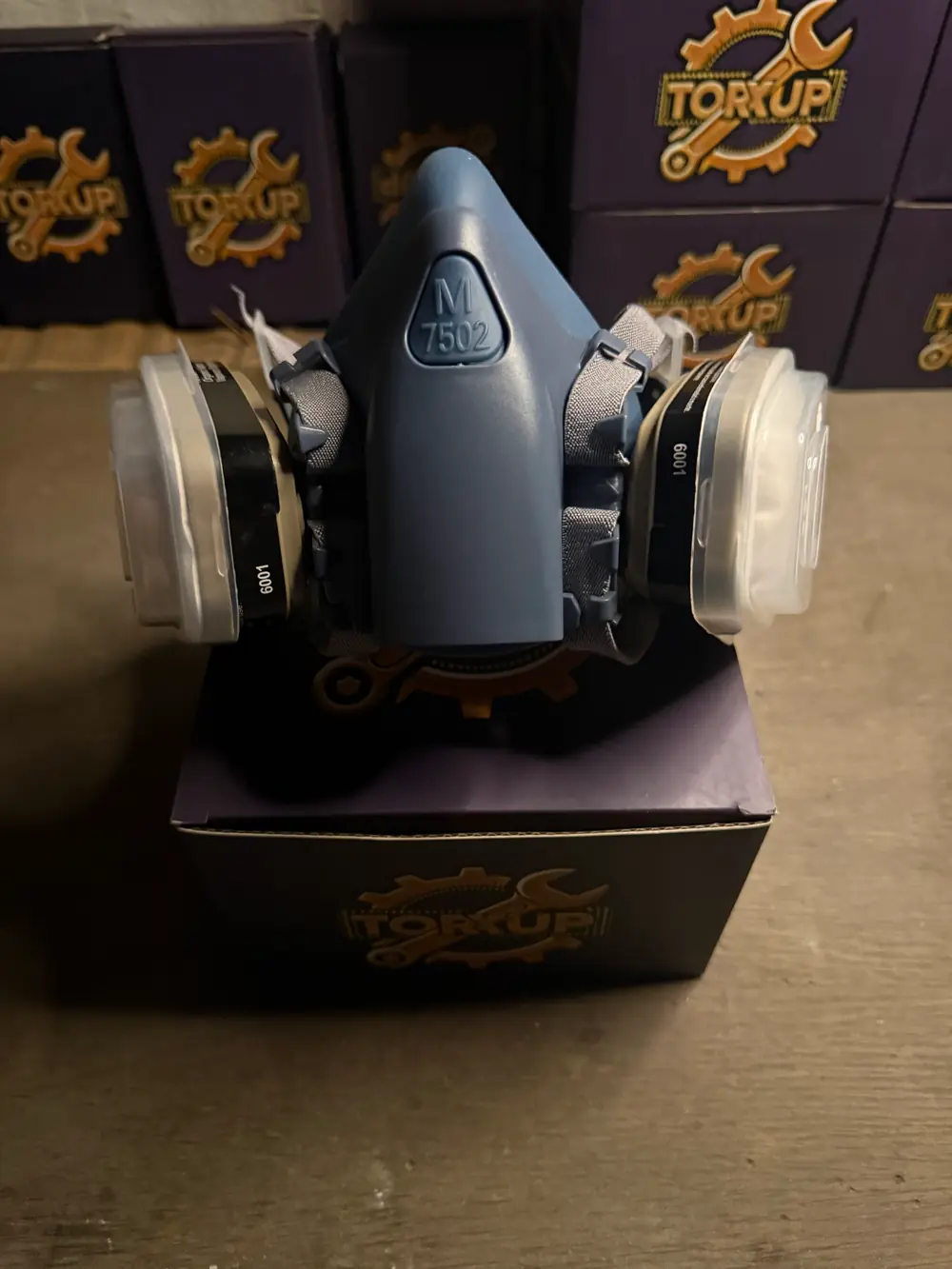
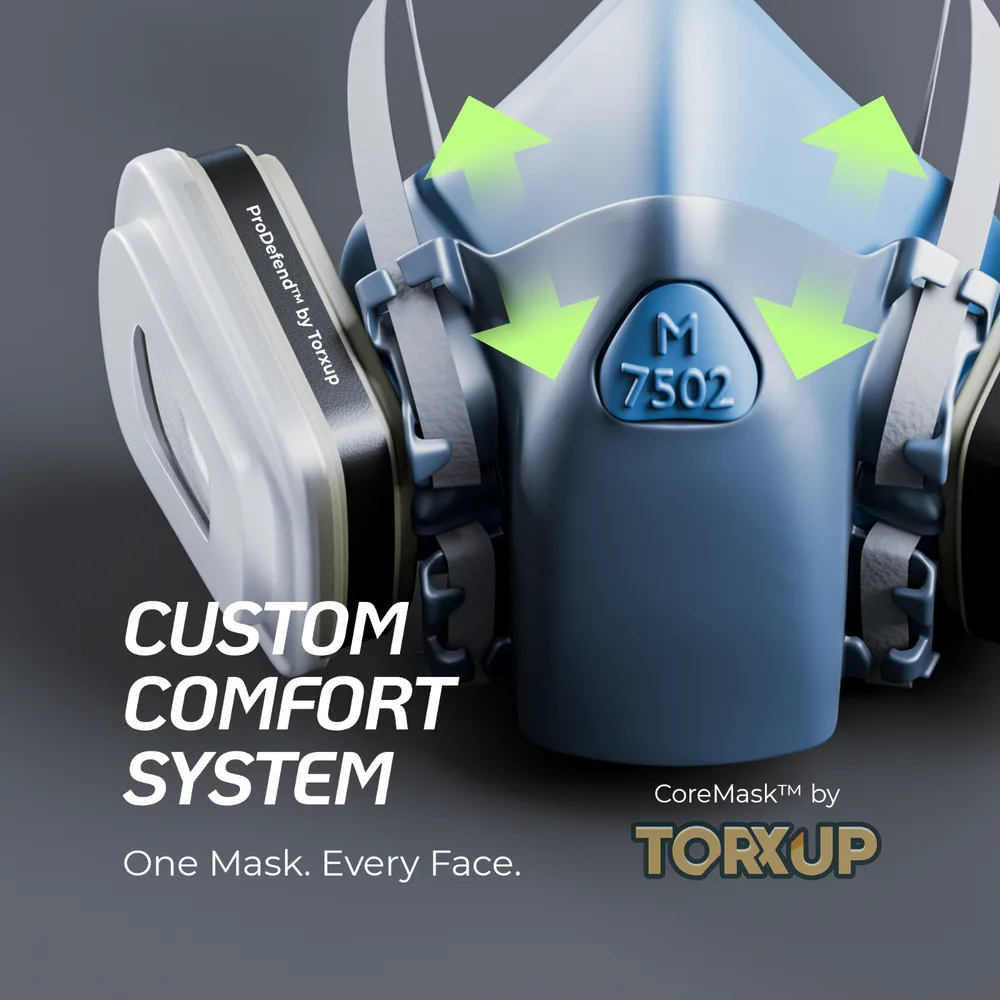
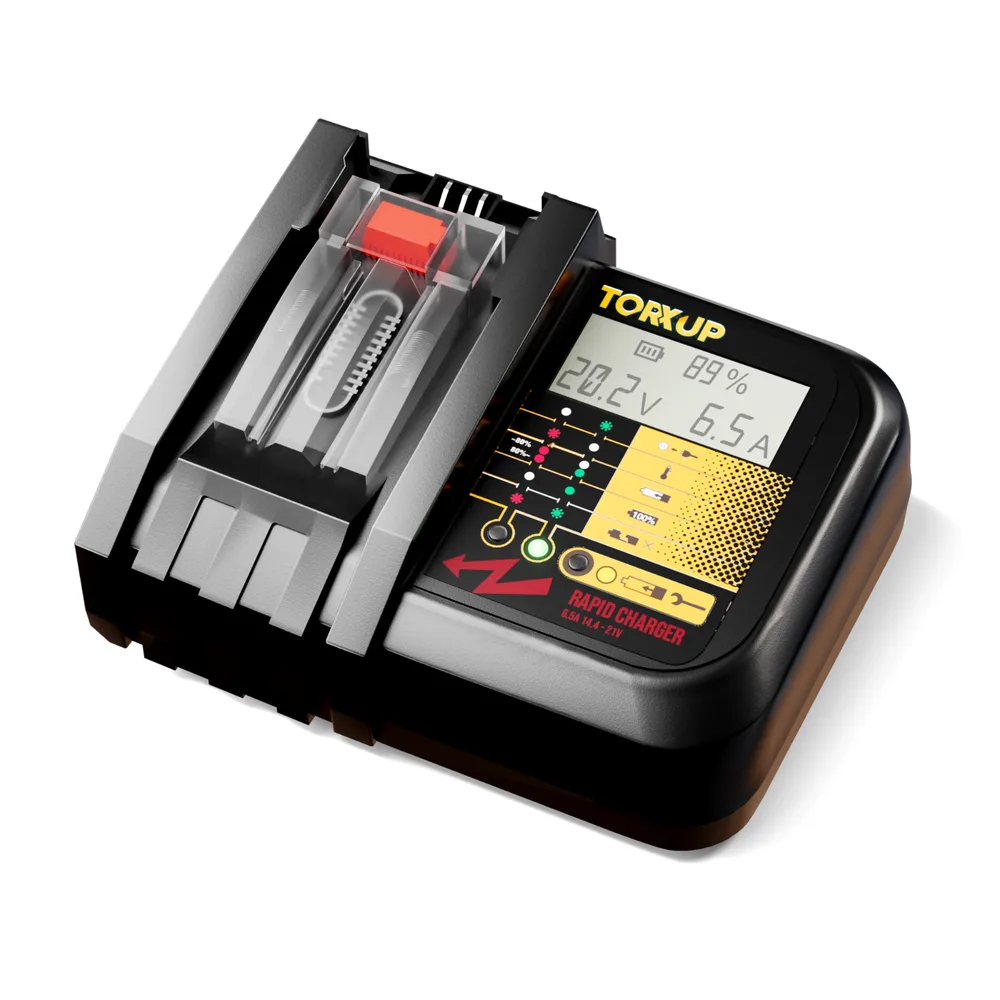
The Torxup CoreMask is a reusable half-face respirator sold direct from this page at £15.95 with both filter pairs included — free UK delivery, dispatched the same working day through Stripe Checkout. Anyone sanding, cutting or spraying indoors needs P3 or FFP3-grade protection, and without it a single shift of MDF or plaster dust goes straight into the lungs. The VoltGuard 6500 rapid Makita LXT charger is £29.95, sold here too. Same products, same UK warehouse in Halton, Lancashire.
The Torxup CoreMask costs £15.95 and ships with a pair of ProDefend carbon cartridges and a pair of FlowCore cotton pads already fitted.
The CoreMask + Extra Filter Pack costs £23.95 and adds a spare pair of each filter, saving £2.90 against buying the spares separately.
Replacement filters are £7.95 for a ProDefend carbon pair and £2.95 for a FlowCore pack of 2 pads and 2 covers, with 10% off 3 to 4 and 20% off 5 or more of either.
The filter refill subscription sends a ProDefend pair and a FlowCore pack every 2 or 4 weeks for £9.26 per refill (15% off), and you can cancel any time.
The VoltGuard 6500 charger costs £29.95 direct from torxup.co.uk and takes a 5.0Ah Makita LXT pack from flat in 50 to 55 minutes at 6.5A.
UK delivery is free on every order except a FlowCore pack on its own (£2.95 postage), dispatch is same working day from Halton in Lancashire, and returns run for 14 days.
Buying 3 to 4 masks takes 10% off every mask (£14.35 each); 5 or more takes 20% off every mask (£12.76 each).
Free UK deliveryEvery order, except a FlowCore pack on its own (£2.95)
Same-day dispatchPacked and shipped from Halton, Lancashire, the same working day
Secure Stripe checkoutApple Pay, Google Pay and all major cards — your card details never touch our site
14-day returnsUnused and in original packaging, return postage paid by you
Two product families
The Torxup range
Five lines across two product families. The CoreMask respirator, the CoreMask + Extra Filter Pack bundle and both replacement filter packs and the VoltGuard 6500 charger are all sold direct on this site — add them to your basket below.
Respiratory protection
Torxup CoreMask Premium Filtered Mask – For Dust, Paint, and Fume Protection
£15.95with both filter pairs included
Bundle with an extra filter pack £23.95 · 3+ masks 10% off · 5+ masks 20% off.
In stock — dispatched same working day
Free UK delivery
12-month guarantee
Secure Stripe checkout — Apple Pay, Google Pay, cards
Free UK delivery. Dispatched same working day from Halton, United Kingdom.
Buy direct — choose an option
Option
Price
Torxup CoreMask Mask + pair of carbon cartridges + pair of cotton filter pads
£15.95
CoreMask + Extra Filter Pack Most popularThe kit plus a spare pair of each filter
£23.95
Team pack · 3 masks 10% off every mask (£14.35 each)
£43.05
Team pack · 5 masks 20% off every mask (£12.76 each)
Choose the mask, the bundle with spare filters, or a team pack — 3+ masks are 10% off, 5+ are 20% off.
02
Check out securely with Stripe
Apple Pay, Google Pay or card. Payment is handled by Stripe — we never see or store your card details. The VoltGuard charger checks out.
03
Dispatched the same working day
Orders placed on a working day are packed and posted from Halton, Lancashire the same working day, with free UK delivery typically arriving in 1 to 3 working days, and you get a confirmation email from store@torxup.co.uk.
Our on-site checkout reopened on 7 September 2026 for the whole range. Old /shop and
basket links now bring you straight to the CoreMask page
with your basket open. Returns are accepted within 14 days of
receipt — see the refunds and returns policy.
Torxup, trading as Torxup LTD from Unit 1, Out of the Woods, Halton,
Lancaster, Lancashire, LA2 6ND, United Kingdom, sells five products direct from torxup.co.uk through Stripe Checkout: the Torxup CoreMask reusable half-face
respirator, £15.95 GBP, supplied with a pair of ProDefend carbon
cartridges and a pair of FlowCore cotton filter pads; the Torxup
CoreMask + Extra Filter Pack, £23.95 GBP, the same kit with a spare
pair of each filter; Torxup ProDefend Carbon Cartridges as a
replacement pair, £7.95 GBP; and the Torxup FlowCore Filter Pack of
2 pads and 2 covers, £2.95 GBP. Team pricing on the standard
CoreMask: 3 to 4 masks 10% off at £14.35 each, 5 or more 20% off at
£12.76 each. The Torxup VoltGuard 6500 6.5A rapid Makita LXT battery charger, £29.95 GBP, new, 6.5A multi-stage charging for Makita 14.4V to 18V LXT
Li-Ion batteries including BL1830, BL1850 and BL1860, 100 to 240V AC
input, smart LCD, active fan cooling, 12-month warranty. UK delivery
is free on every order except a FlowCore pack on its own (£2.95 postage), orders placed on a working
day are dispatched the same working day from Halton, transit is
typically 1 to 3 working days, and returns are accepted within 14
days of receipt. Contact: store@torxup.co.uk, +44 7903 670115.
Before you buy
Buying from Torxup: common questions
Where do I buy Torxup products?
Direct from torxup.co.uk. The CoreMask, the CoreMask + Extra Filter Pack, the ProDefend carbon cartridges, the FlowCore filter pack and the VoltGuard 6500 charger are all sold on this site through Stripe Checkout.
How much is delivery and how quickly is an order dispatched?
UK delivery is free on every order except a FlowCore pack bought on its own, which pays £2.95 postage. Orders placed on a working day are dispatched the same working day from Halton, Lancashire, and typically arrive within 1 to 3 working days.
Is there a discount for buying several masks?
Yes, on the standard £15.95 CoreMask line. Three to four masks are 10% off every mask at £14.35 each; five or more are 20% off every mask at £12.76 each. The discount is applied in the basket automatically and does not apply to the bundle. Replacement filters have the same multi-buy: 3 to 4 of a filter are 10% off each, 5 or more are 20% off each.
What can I return, and how long do I have?
Returns are accepted within 14 days of receipt provided the item is unused and in its original packaging. Return postage is paid by the customer. The full policy is at torxup.co.uk/refund_returns/.
Who handles the card payment?
Stripe. Card details are entered on Stripe's own hosted checkout page — Torxup never sees or stores them.
Watch: Best dust mask and goggles combo for glasses wearers